Cognitive Science
Why Your Brain Mixes Languages (And Why That's Actually Good)
On code-switching, false friends, and what 152 studies got wrong about the "bilingual advantage."
August 10, 20258 min read
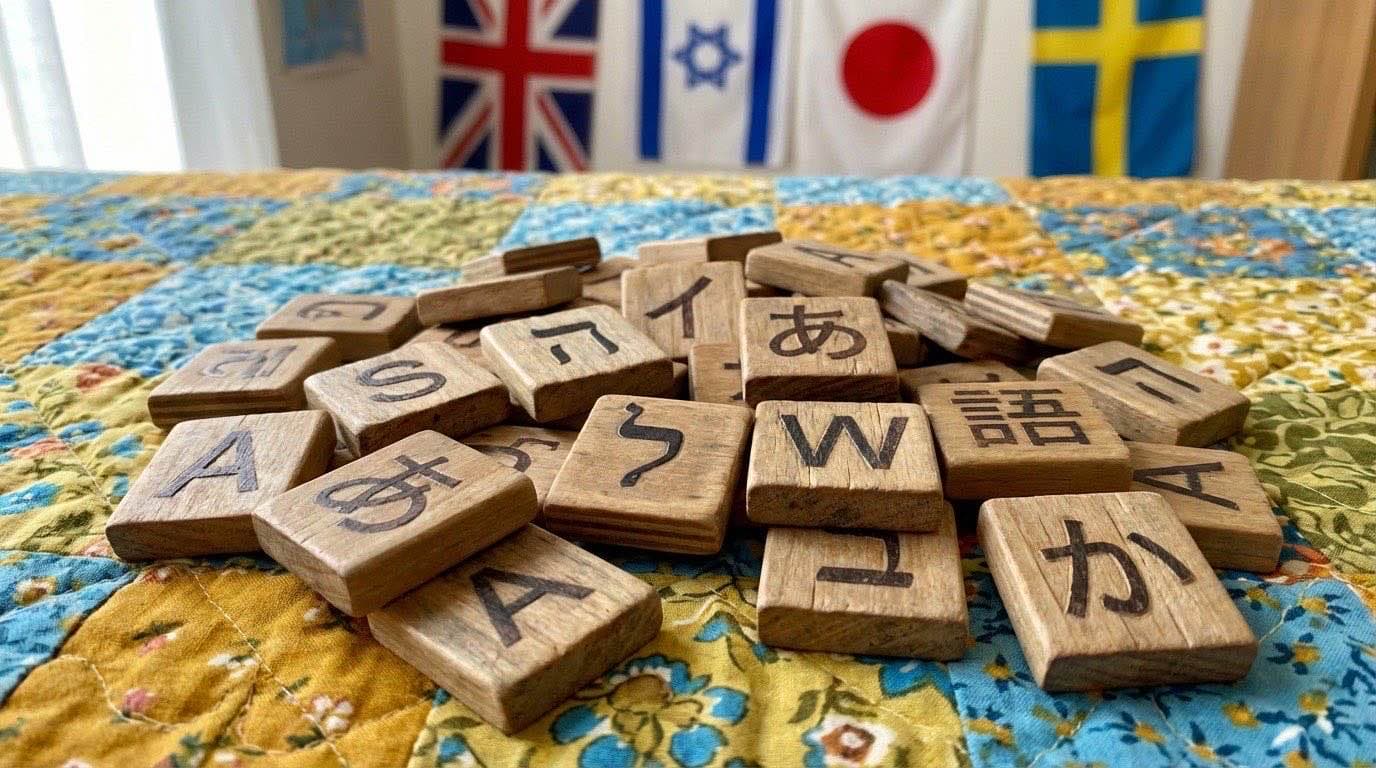
I was three rounds into a LexiClash session in English when my brain decided — completely unprompted — to spell "bibliotek." That's Swedish for library. I don't live in Sweden. I wasn't thinking about Sweden. I was trying to make "bottle" out of B-I-O-T-L-E-K and my brain went, "You know what fits? A Swedish word. You're welcome."
If this has ever happened to you — mixing languages mid-game, mid-sentence, mid-thought — your brain isn't broken. It's actually running something fascinating. And recent research suggests the very thing that feels like a glitch might be a feature.
Fair warning: the "bilingual advantage" is one of the most contested ideas in cognitive science right now. Some of the claims about language mixing have been wildly overstated. I'm going to tell you what we actually know, where the science gets shaky, and why playing word games in multiple languages is still worth your time.
How two languages stay active at the same time
Back in 1994, Judith Kroll and Erica Stewart proposed the Revised Hierarchical Model. Sounds academic. It's actually intuitive.
Imagine your brain has a filing cabinet labeled "Concepts" — dog, love, justice, that embarrassing thing you said in 2007. Then you have separate drawers for each language. One for English words, one for Swedish, one for whatever else you speak.
When you're a beginner in a new language, you can't go directly from concept to word. You have to route through your first language. You see a dog, think "dog" in English, then translate to "perro" or "hund." It's slow. It's effortful.
But as you get more proficient, your brain builds direct highways from concepts to your second language. You see a dog and think "hund" without the English detour.
Except the old route never fully shuts down. Both languages remain active simultaneously. All the time. Even when you're only using one. Your brain is running two (or three, or four) language systems in parallel, whether you asked it to or not.
This is why you type "bibliotek" when you mean "bottle." Your Swedish lexicon was sitting in the background the whole time, occasionally shouting suggestions.
Languages compete, not queue
Research published in Bilingualism: Language and Cognition confirmed something multilingual people always knew: your languages compete for access. It's not a polite queue. It's a mosh pit.
When you're using English, your brain has to actively suppress your other languages. The technical term is "inhibitory control." Your prefrontal cortex is essentially telling Swedish to sit down and be quiet while English has the microphone. When you switch to Swedish, your brain flips that around.
This takes real cognitive effort. It's measurable. It's one reason bilinguals sometimes take a fraction of a second longer to retrieve words in either language — both systems are interfering with each other.
For word game players, this gets practical fast. After an hour of playing in English, the suppression on your other language weakens. Your brain gets tired of being the bouncer. Swedish words start leaking through. Hebrew characters appear at the edges of your consciousness. And suddenly you're trying to play Hebrew on an English board.
This isn't a bug. It's your brain's resource management system running low on fuel.
The bilingual advantage debate
Most articles will tell you that speaking multiple languages makes you smarter, more empathetic, better at multitasking. The reality is messier.
The "bilingual advantage" hypothesis — managing two languages gives you better executive function — was popular in the 2000s and 2010s. Ellen Bialystok's lab produced study after study showing bilinguals outperforming monolinguals on inhibitory control tasks.
Then came the replication crisis. A 2019 meta-analysis by Lehtonen and colleagues examined 152 studies and found small to negligible effects once publication bias was accounted for.
Does this mean bilingualism has no cognitive benefits? No. It means the benefits are probably more specific and context-dependent than headlines suggested. Some studies do find advantages, particularly in certain populations under certain conditions. The key question isn't "does bilingualism help?" but "when, how much, and for whom?"
A 2023 study in Frontiers in Psychology found that regular code-switchers — people who actively bounce between languages — showed advantages in inhibitory control. The crucial word: regular. It wasn't passive bilingualism. It was active, frequent switching in real contexts.
Which, if you think about it, is exactly what you're doing when you play word games in multiple languages.
False friends: the multilingual landmines
If you've ever played word games across languages, you've stepped on a false friend. It's always funny until it happens to you.
False friends are words that look similar across languages but mean completely different things. "Gift" in English means present. "Gift" in Swedish means poison (or married, depending on context). Germanic languages apparently have strong feelings about presents.
"Embarrassed" in English vs. "embarazada" in Spanish — which means pregnant. "Preservatif" in French doesn't mean preservative. It means condom.
For word game players, false friends create unique cognitive interference. You see G-I-F-T and your brain has to resolve: am I playing in English (good word, means present) or Swedish (also good word, means poison)? The letters are identical. But your brain insists on activating the meaning alongside the form, because that's what brains do with language.
I've lost more LexiClash rounds to false friends than I'd like to admit. Playing Swedish after an English session, I once convinced myself "bra" was a valid English word meaning "good." It is a valid English word. Just not the one my Swedish brain was thinking of.
Pattern recognition transcends language
Nigel Richards is a New Zealander who speaks English. He won the English-language World Scrabble Championship five times. Then, in 2015, he won the French-language World Scrabble Championship without speaking French.
He memorized the entire French Scrabble dictionary — roughly 386,000 words — without understanding what any of them meant. He treats words as pure patterns. Letter combinations. Mathematical objects.
What does this tell us? That lexical knowledge (knowing words) and semantic knowledge (knowing what words mean) are genuinely separable in the brain. The Revised Hierarchical Model predicted exactly this.
More importantly: the pattern recognition you develop playing word games in one language doesn't disappear when you switch to Hebrew or Japanese. The specific letters change, but the underlying cognitive machinery stays the same. Scanning for patterns, evaluating possibilities, weighing probabilities.
You don't need to be a savant to benefit. Engaging with different writing systems — right-to-left Hebrew, multiscript Japanese, irregular English — exercises your brain's pattern-matching circuits in ways monolingual play doesn't touch.
The "tip of the tongue" paradox
Here's something counterintuitive: bilinguals experience more tip-of-the-tongue moments than monolinguals. Not fewer. More.
Research by Gollan and Acenas (2004) found that bilinguals experience this more frequently in both their languages. The reason goes back to competition. When you have two lexicons competing for activation, each individual word gets slightly less total activation than in a monolingual system. It's like splitting your bandwidth between two WiFi networks.
The paradox: this apparent weakness might be training a strength. Every time your brain resolves a tip-of-the-tongue moment — every time it successfully retrieves the right word from the right language despite interference from the other — it's exercising the same retrieval and inhibition circuits that underlie executive function.
Think of it like weight training. The extra resistance makes each rep harder. But it also makes you stronger.
I notice this in LexiClash constantly. When I switch from English to Hebrew, the first minute or two feels like running through mud. Words come slower. I second-guess letters. But by the third round, something shifts. My brain has adjusted its filters, and Hebrew words start flowing. And when I switch back to English afterward? It feels sharper than when I started. Like I've been doing cognitive stretches.
That's anecdotal. I'm one person. But the research on code-switching and cognitive flexibility supports the pattern.
Four languages, four brain workouts
Full disclosure: I play LexiClash and love it. But there's genuinely something interesting about a word game supporting Hebrew, English, Swedish, and Japanese. These aren't four variations on a theme. They're four fundamentally different writing systems.
English is an alphabet with notoriously irregular spelling. You need strong memorization alongside pattern recognition. The challenge is orthographic — "ough" makes seven different sounds.
Swedish is also alphabetic and deceptively similar to English. Close enough to lull you into false security. Then you hit "sju" and realize Swedish pronunciation is an elaborate practical joke.
Hebrew operates right-to-left with an abjad system — consonants are primary, vowels often omitted. Playing in Hebrew requires a fundamentally different kind of pattern recognition. Research suggests bidirectional readers develop more flexible spatial attention.
Japanese uses three scripts simultaneously — hiragana, katakana, and kanji. Playing Japanese exercises a completely different dimension of linguistic processing.
When I play all four languages in one session, the cognitive experience is noticeably different each time. English feels like solving a familiar puzzle. Swedish feels like solving that puzzle in a funhouse mirror. Hebrew feels like solving it backward (because you literally are). Japanese feels like solving three different puzzles at once.
After months of this, I get better at all of them. Not just incrementally, but in ways that feel connected. Getting faster at Hebrew pattern recognition makes me notice letter clusters in English that I used to miss. The lateral thinking required for Japanese helps me see longer words in Swedish.
The research on multilingual cognition is far from settled. The bilingual advantage may turn out smaller or more specific than we hoped. But here's what's clear: using language actively, in engaging contexts, with emotional investment — that's how the brain learns.
A word game you actually enjoy playing is worth more than a flashcard deck you'll abandon in a week. And a multilingual word game? That's genuine bonus.
Play in your strongest language first to warm up. Then switch to another. Don't worry when the first minute feels clunky — that's inhibition reshuffling. Normal.
Try languages that are structurally different from each other. English and Swedish are fun, but the real cognitive stretch comes from adding something like Hebrew (RTL) or Japanese (multiple scripts).
Don't beat yourself up over false friends and cross-language interference. It's not weakness. It's a sign your languages are deeply integrated, which is exactly what you want.
And embrace the tip-of-the-tongue moments. They're annoying, but they're your brain doing reps.
Now if you'll excuse me, I need to go figure out why my brain thinks "lagom" should be an English word. It should be. It's a great word. But that's another article.
Sources: - Kroll, J. F., & Stewart, E. (1994). Category interference in translation and picture naming: Evidence for asymmetric connections between bilingual memory representations. Journal of Memory and Language - Bilingualism: Language and Cognition research on inhibitory control and language suppression (2019+) - Lehtonen, M., et al. (2019). Bilingualism: Language and Cognition meta-analysis (152 studies); Frontiers in Psychology (2023) on code-switching and executive function - Gollan, T. H., & Acenas, L. A. (2004). What is a TOT? Cognate and language effects on tip-of-the-tongue states in Spanish-English and Tagalog-English bilinguals. Journal of Memory and Language - Bialystok, E. (2007). Bilingualism and Executive Function. Neuropsychologia (foundational work on multilingual cognition) - Revised Hierarchical Model: Kroll & Stewart (1994) and extensions in contemporary neurolinguistics

Ohad Fisher
Founder & Editor-in-Chief, LexiClash
Founder and editor-in-chief of LexiClash. 8+ years designing word games and reading cognitive-science research. Every claim in my articles is sourced and fact-checked against peer-reviewed studies — see our editorial policy.