Science
The Science Behind Word Games: What Actually Happens in Your Brain
fMRI scans, a $50 million scandal, and why your grandma is probably onto something with her crosswords.
July 3, 20257 min read
I spent three hours last Tuesday staring at a 4x4 grid of letters trying to find a seven-letter word. Three hours. My coffee went cold. My cat gave up on dinner. When I finally found it (STRANGE, cutting diagonally across the board) I pumped my fist like I'd won the World Cup.
My partner looked at me like I needed professional help.
Here's the thing. While I was sitting there looking unhinged, my brain was running one of the most complex cognitive routines it knows how to run. Not in the hand-wavy "brain training makes you smarter" way that got Lumosity hit with a $50 million FTC fine. In a specific, measurable, fMRI-evidence way.
This piece walks through the actual neuroscience of word games. Real studies, real numbers. I'll also flag where the science ends and the marketing begins, because this field has a credibility problem you deserve to know about.
Your brain on word games: the fMRI evidence
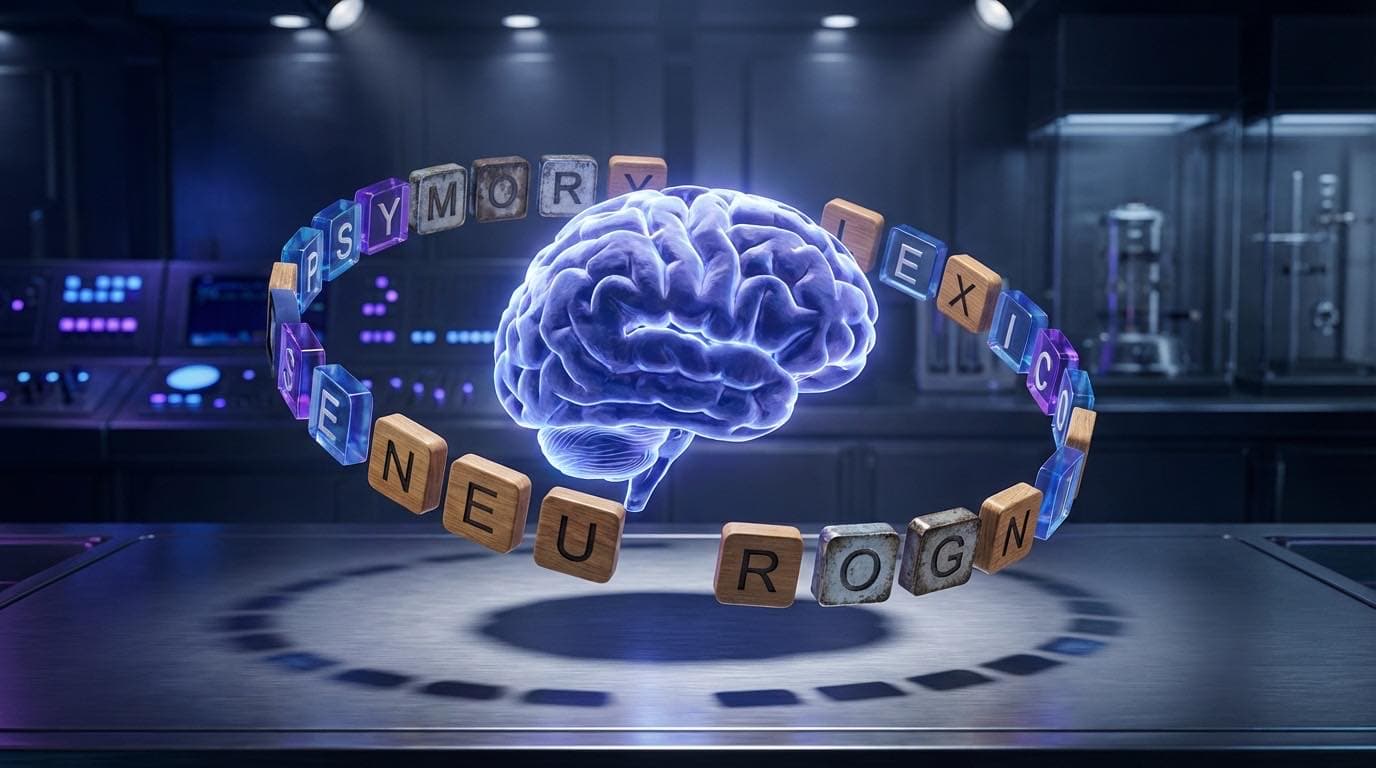
An fMRI machine is a loud, claustrophobic tube that takes pictures of blood flow in your brain. Researchers stick volunteers inside, show them a grid of letters, and ask them to find words.
A lot more lights up than you'd think.
A 2021 systematic review in AIMS Neuroscience pulled the fMRI literature on word processing together and found four brain regions firing in parallel during search.
Broca's area sounds the letters out. Even when you read silently this area activates, because your brain subvocalizes. You can almost feel it: the slight motion of your lips, the inner voice trying combinations.
Wernicke's area handles meaning. The part that says "GRAT? no. GRATE? yes." It cross-references your mental dictionary at a speed I find hard to believe.
The dorsolateral prefrontal cortex is the air traffic controller. It decides which leads to follow, when to abandon a dead end, and how to allocate attention across the grid.
The basal ganglia jump in when things get hard. CAT is easy, so they relax. CATASTROPHE makes them work overtime.
There's a fifth player nobody talks about: the phonological loop. This is your brain's RAM for language. It holds a few syllables active by silently rehearsing them, the way you repeat a phone number until you dial it. When you scan a letter grid, you're running dozens of candidate combinations through this loop every second.
I tested this once. I tried playing while counting backwards from 100 by sevens. Brutal. My score dropped about 60%. Counting backwards hijacks the same loop word-finding needs, and the loop can only do one job at a time. That's also why a noisy room kills your score. Other people's words intrude on the loop whether you want them to or not.
A 2019 meta-analysis in Frontiers in Human Neuroscience backs this up: verbal working memory activates the left prefrontal cortex, spatial working memory lights up the right. Two separate systems, both running while you hunt for STRANGE.
Hard mode, and Hagoort's three-engine model
Studies consistently show a direct, measurable link between how hard a word task is and how much brain gets recruited. Easy words: a few regions handle it. A long, weird, multi-directional word: your brain calls in reinforcements. Pre-motor regions activate. The cerebellum, usually filed under balance and coordination, gets pulled into the cognitive coordination.
This is why a hard word game feels physically different. Your forehead tenses. You lean forward. Same legs, very different intensity from a casual walk.
Peter Hagoort, a Dutch neuroscientist at the Max Planck Institute, proposed a model that fits word games almost perfectly. He calls it MUC: Memory, Unification, Control.
Memory is the retrieval system. It pulls candidates from your mental lexicon. You see S, T, A, R and your memory immediately serves up STAR, TARS, RATS, ARTS, and a dozen others.
Unification happens in Broca's area. Candidates get tested against phonological rules, morphological patterns, and meaning. The QA department.
Control sits in the DLPFC. It picks where to focus, which candidate to chase, when to bail on a path. This is the strategic layer that makes you better over time as you learn search patterns.
All three engines run at once. Retrieve, test, strategize, in parallel. The fact that your brain manages this while you sit there muttering "hmm, what about... no, that's not a word" is genuinely staggering. Next time someone calls word games a silly pastime, remind them.
The Lumosity scandal you should know about
In 2016 the Federal Trade Commission fined Lumosity, then the biggest name in brain training, $50 million. Fifty. Million. Dollars.
The reason: Lumosity claimed their games could help users perform better at work and school, delay age-related cognitive decline, and reduce impairment associated with Alzheimer's. The FTC found those claims unsupported by the evidence and stated that Lumosity "preyed on consumers' fears about age-related cognitive decline."
This is essential context for everything else here. The brain-training industry has a credibility problem. Too many companies have sold vague promises about "neuroplasticity" without research to back them up.
So to be clear: I am not telling you word games will make you smarter, prevent Alzheimer's, or boost your IQ. Anyone telling you that is either uninformed or selling something.
What I am telling you is what neuroscience actually shows about what happens in your brain while you play. Different conversation entirely.
What the research actually shows
With the caveat in place, here is what we can say with reasonable confidence.
Verghese and colleagues published a landmark study in the New England Journal of Medicine in 2003 that followed 469 adults over a 21-year window. Participants who did crossword puzzles three or four days a week had about a 38% lower risk of developing dementia than non-puzzlers. The result was correlational, not causal, but the effect size was large and the sample was tracked for two decades.
The PROTECT study out of the University of Exeter and King's College London (2019) added another data point. Over 19,000 adults aged 50+ self-reported their word-puzzle habits, then sat for cognitive tests. Regular word-puzzle users scored on attention, reasoning, and memory tasks at levels equivalent to brains roughly ten years younger than their chronological age.
Both studies are correlational. They cannot prove word puzzles caused the better performance. People who are already sharper might just be more likely to enjoy word puzzles. Chicken-and-egg.
But the effect sizes are big enough to take seriously. A 38% lower dementia risk and a ten-year apparent cognitive age gap are not statistical noise.
My honest read: even if word games do not make you "smarter" in any measurable way, sustained focused linguistic effort is almost certainly better for your brain than passive scrolling. The bar is not "does this cure dementia". The bar is "is this a good use of my mental energy". Yeah. I think it is.
Why word games hit different (and the multilingual twist)
Not all cognitive activities are equal. Word games have something Sudoku and pattern-matching don't.
Language is woven through the whole brain. It's not a module in one corner. Memory, motor control, emotional processing, social cognition, abstract reasoning all get touched. When you play a word game you engage a distributed network rather than one isolated pathway. Compound exercise, not isolation curl.
There's also a vocabulary payoff. Every word you encounter that you didn't know, or rediscover after forgetting, strengthens a neural connection. Unlike most brain-training tasks, that has real-world use. A bigger vocabulary helps you read faster, write clearer, follow more nuanced argument. I learned QUAFF from a word game three years ago. Used it six times since. Worth three hours of one Tuesday? Debatable. Mine now.
The multilingual angle is where it gets interesting. For bilingual or multilingual players, the brain has to manage not just word search but also language selection, keeping it hunting in the right lexicon. That extra control demand recruits more prefrontal cortex and the anterior cingulate cortex, the region that resolves conflict between competing options.
Bialystok and colleagues at York University published a study in Neuropsychologia in 2007 that tracked 184 patients at a memory clinic. Bilinguals showed Alzheimer's symptoms about four years later than monolinguals, even after controlling for education and immigration history. Correlation again, but four years is a long time.
LexiClash runs in English, Hebrew, Swedish, Japanese, Spanish, and Russian. A bilingual player who switches between two boards in one session is doing the cognitive equivalent of adding plates to a barbell. Same lift, more weight.
Should you play more word games?
I'm biased. I spent three hours on one word and called it a good Tuesday. Strip out the bias and here is the honest read.
The neuroscience is solid. Word games activate complex, distributed brain networks. Memory retrieval, phonological processing, executive control, motor systems. Not disputed.
The cognitive benefits are suggestive but not proven. Large studies show correlations between word-puzzle engagement and better cognitive outcomes. Causation is unclear.
The brain-training industry has earned its skepticism. After Lumosity's $50 million lesson, anyone making big claims should be eyed carefully. "Brain training" is marketing, not science.
But word games are one of the few activities that are simultaneously hard, linguistically enriching, genuinely fun, and social if you play with someone. That combination is rare.
You don't need neuroscience to justify playing. They're fun. That's enough. But if you wanted to know that something genuinely interesting is happening in your skull while you hunt for that seven-letter word, now you do.
Anyway, I've got a grid waiting.
Sources: - Systematic review of fMRI studies on word processing: AIMS Neuroscience (2021) - Meta-analysis of verbal vs. spatial working memory: Frontiers in Human Neuroscience (2019) - Verghese, J. et al. "Leisure Activities and the Risk of Dementia in the Elderly": New England Journal of Medicine (2003), n=469, 21-year follow-up - Brooker, H. et al. PROTECT study, 19,000+ adults aged 50+: University of Exeter and King's College London (2019) - Hagoort, P. MUC (Memory, Unification, Control) model: Max Planck Institute - Bialystok, E., Craik, F. I. M., and Freedman, M. "Bilingualism as a protection against the onset of symptoms of dementia": Neuropsychologia (2007), n=184 - FTC v. Lumos Labs (Lumosity): $50M settlement for deceptive advertising (2016)

Ohad Fisher
Founder & Editor-in-Chief, LexiClash
Founder and editor-in-chief of LexiClash. 8+ years designing word games and reading cognitive-science research. Every claim in my articles is sourced and fact-checked against peer-reviewed studies — see our editorial policy.