Techniques
I Spent 3 Years Getting Better at Word Games. Most of What I Tried Was Useless
The actually useful stuff fits on a napkin. The rest is ego and Scrabble Twitter drama.
September 15, 20258 min read

I have a confession that will make competitive word game players groan. For my first year of "serious" play, I memorized two-letter Scrabble words. All of them. QI, ZA, XI, JO, the works. I crammed hundreds of words into my head like I was training for a spelling bee.
Know what happened? I got marginally better at Scrabble specifically, and absolutely no better at any other word game. My Boggle scores didn't budge. My anagram-solving speed stayed the same. I had stuffed data into my head without actually improving the skill I cared about: seeing words in chaos.
Then I read about Nigel Richards, and everything fell apart.
Pattern recognition beats memorization
Nigel Richards won the French-language Scrabble World Championship. Twice. He does not speak French. He memorized roughly 386,000 French words as pure letter patterns, with no idea what they meant. He also won the Spanish championship. Does not speak Spanish. His tournament winnings make him arguably the greatest board game player alive.
When I first heard this, I thought it proved memorization was the answer. I was wrong. What it actually proved is that Richards does not just memorize words—he recognizes letter patterns at a level most people simply cannot perceive. French-language Scrabble players who interviewed him said he spots valid seven-letter plays faster than native speakers. He is not retrieving definitions from memory. He is seeing structural patterns that most brains cannot parse.
That distinction changed everything about how I practice. Pattern recognition, not raw recall, is the bottleneck. Your brain needs to see SATIRE hiding inside ASTRIDE, not remember that SATIRE is a word.
What your brain actually does when searching
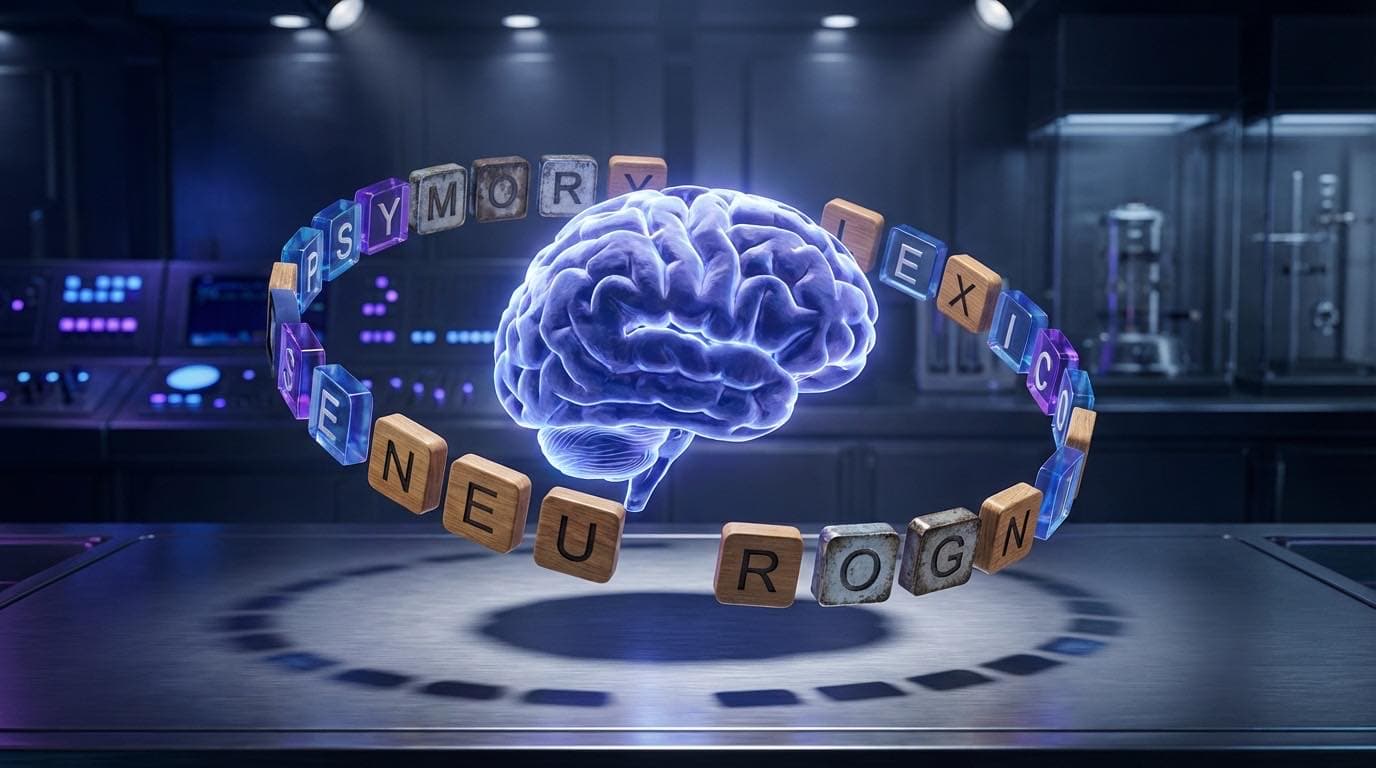
Researchers studying competitive Scrabble players with fMRI found something counterintuitive. Expert players activate visual processing areas, not language processing regions, when they scan tiles. Their brains treat letter arrangements like spatial puzzles, not linguistic problems.
The best word finders in the world are not thinking about words. They are seeing them. The way you spot a face in a crowd, they spot patterns.
A 2021 systematic review in AIMS Neuroscience identified four brain regions firing simultaneously during word search. Broca's area handles phonological sounding—your inner voice testing combinations. Wernicke's area checks meaning, cross-referencing candidates against your mental dictionary at speeds I find hard to believe. The dorsolateral prefrontal cortex acts as traffic control, deciding which leads to follow and when to abandon dead ends. The basal ganglia jump in when the task gets hard: CAT is easy, so they relax; CATASTROPHE makes them work overtime.
There is also your phonological loop—the brain's RAM for language. It holds a few syllables active by silently rehearsing them, the way you repeat a phone number until you dial it. When you scan a letter grid, you are running dozens of candidate combinations through this loop every second. I tested this once. I tried playing while counting backward from 100 by sevens. My score dropped 60%. Counting backward hijacks the same loop word-finding needs, and the loop can only do one job at a time.
This is why memorizing word lists feels productive but is not. You are adding database entries. What you actually need is better pattern-matching firmware. Carnegie Mellon professor Michael Ramscar teaches cognitive science through Scrabble, demonstrating exactly this: humans chunk letters into familiar groups and test those chunks against known patterns. Massively more efficient than checking every permutation. But it only works if you have built those chunks through experience.
Deliberate practice: the unglamorous truth
You have heard about the 10,000 hours rule. K. Anders Ericsson researched it, the internet mangled it. Here is what he actually found: it is not about hours. It is about deliberate practice. Working on specific weaknesses with immediate feedback, at the edge of your ability. A chess player playing 10,000 hours of casual blitz will improve far less than someone who studies specific positions for 2,000 hours with a coach.
Same applies to word games. I played casually for years. Got marginally better. Hit a wall. Played more. Stayed exactly where I was. Frustration mounting. Thinking maybe I had hit my ceiling.
Then I changed my approach entirely. Instead of just playing games, I did targeted fifteen-minute anagram drills with a timer. Not to memorize answers, but to force my brain to process letter combinations faster. When I got stuck on a set of letters, I stopped and studied why. Was it an unfamiliar consonant pair? A suffix I kept overlooking? A vowel-heavy arrangement that made me panic?
The improvement was immediate. Not dramatic, but within two weeks I was finding words 20-30% faster. After a month, I was beating scores I had been stuck on for years. The difference was not knowing more words. It was seeing them faster.
This is the core principle Ericsson identified: working at the edge of your ability, with a specific weakness in focus, produces measurable gains. Passive repetition does almost nothing. Active struggle, with attention to what you are missing, changes your brain.
Visual chunking and the backward reading trick
Researchers studying anagram solving have identified two distinct strategies. Sequential scanning means checking one letter combination at a time. A with B, then A with C, then A with D. Slow. Exhausting. This is what beginners do.
Visual chunking means your brain automatically groups letters into recognized clusters and evaluates multiple combinations simultaneously. TH gets recognized instantly as a unit. -TION at the end of a letter group jumps out. You do not consciously think "T and H often appear together." Your visual system does it before you are even aware.
This cannot be shortcut. You cannot read about chunking and suddenly start doing it. It is a perceptual skill that develops through repeated exposure, like a radiologist learning to spot tumors in X-rays. The radiologist does not memorize what every tumor looks like. They develop sensitivity to anomalies through thousands of hours of looking.
But not all looking is equal. Mindless repetition barely moves the needle. You need active engagement, pushing past comfortable patterns, paying attention to what you miss.
One practical trick: when you feel stuck, read the letters backward. Or rearrange them in your head. Or cover half with your hand and look at the remaining ones. You are breaking what psychologists call functional fixedness—your perception locked into one organizational framework. Reorganizing the same information in a new configuration lets different chunks emerge. The word GARDEN might be invisible when staring at R-E-D-N-A-G, but read those letters backward and it appears.
Timing, plateaus, and breaking through
I tracked my scores for six months alongside when I played. Morning scores—within two hours of waking—ran 15-25% higher than evening scores. This tracks with chronobiology research showing that most people's cognitive performance peaks in the mid-morning. Working memory, attention, and pattern recognition are all measurably sharper at that window.
The reverse is also true. After a bad night of sleep, my scores dropped by a third or more. Pattern recognition is one of the first cognitive abilities to suffer from fatigue. This is not exactly shocking, but the magnitude surprised me. If you are playing a competitive daily challenge, play it when you are fresh. Do not squeeze it in at midnight after a long day and then wonder why your scores are terrible.
Around month eight of deliberate practice, I hit a wall. My scores stopped improving. I was doing everything right. Targeted practice. Pattern exercises. Playing at peak hours. Nothing moved. I seriously considered quitting.
Then I read that Ericsson said skill plateaus are not signs of reaching your limit. They are signs that your current practice strategy has extracted all the improvement it can. You need to change the challenge.
So I did something uncomfortable. I switched from my usual 4x4 grids to 5x5. The larger board was overwhelming at first. My scores cratered. But within three weeks, something shifted. When I returned to 4x4, it felt almost easy. The letters had not changed. My ability to scan larger visual fields had improved.
This is the principle behind overlearning: training at a harder level than what you will face in actual competition. Athletes do it. Musicians do it. It works for word games too. When you hit a plateau, do not quit—make it harder.
The honest truth: you can understand the cognitive science, learn every technique, know exactly how your brain processes language. None of it matters if you do not practice deliberately and consistently.
The good news? Deliberate practice in word games is fun. You are not running wind sprints or practicing scales. You are playing games, just with intention instead of autopilot.
Start with short words. Pay attention to letter clusters. Break your visual fixedness when stuck. Play when you are sharp. And when you plateau, do not quit—make it harder.
That is it. Everything else is details.
Ohad Fisher
Founder & Editor-in-Chief, LexiClash
Founder and editor-in-chief of LexiClash. 8+ years designing word games and reading cognitive-science research. Every claim in my articles is sourced and fact-checked against peer-reviewed studies — see our editorial policy.