Competitive Play
What a Scrabble Tournament Taught Me About How Top Players Really Think
Chess chunking, tile tracking, and why expert players see words completely differently than you do.
August 28, 20257 min read
I thought I was good at word games.
I win at family game night. I know QI and ZA and all the two-letter words that make people say "that's not a word" before you show them the dictionary. Once I played QUIXOTIC on a triple word score and my sister didn't speak to me for the rest of Thanksgiving.
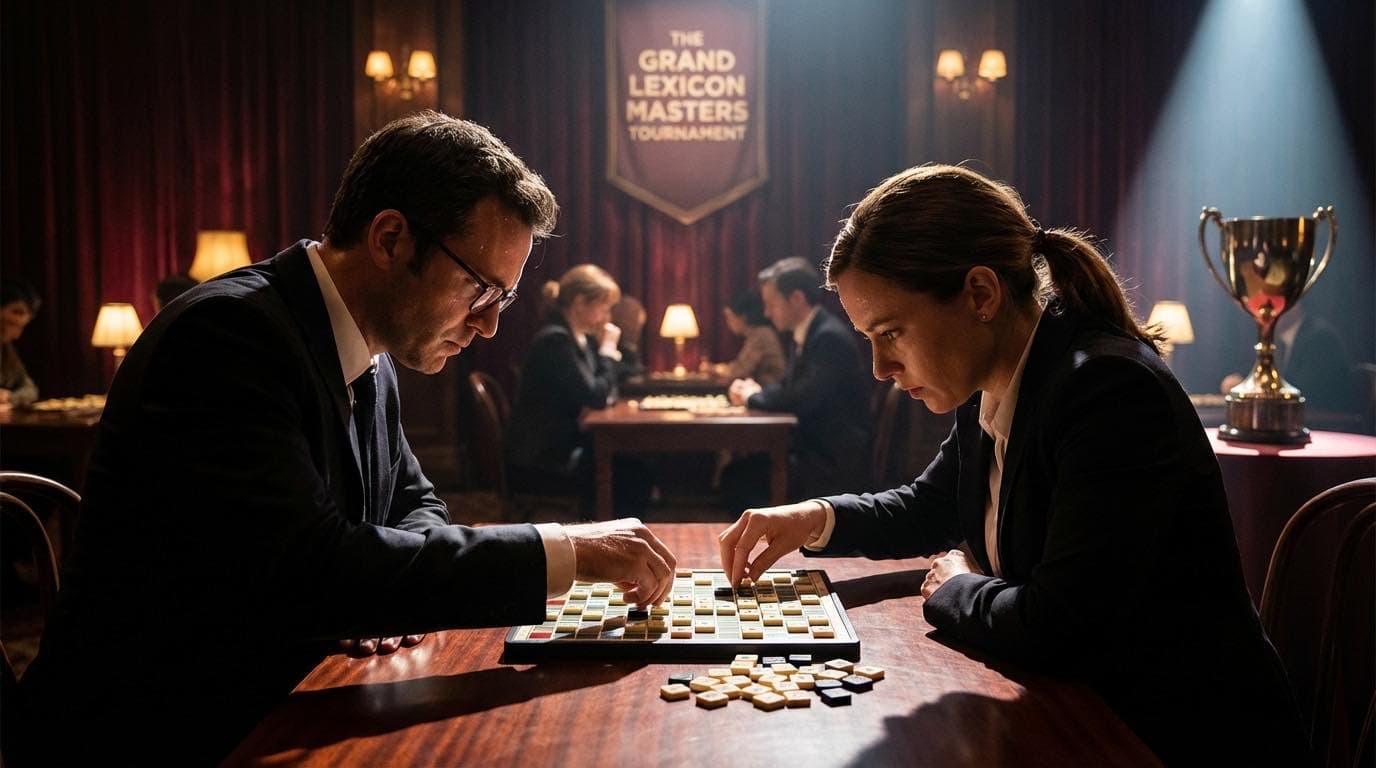
Then I entered a NASPA-sanctioned Scrabble tournament. Very hard. Very fast. I got demolished. But in one weekend I learned more about how expert word game players actually think than I'd picked up in twenty years of casual play. Some of it is backed by fascinating neuroscience. Some of it is just unsettling.
Expert players see words as patterns, not meanings
My first opponent was a quiet woman named Diane. She played CWMS on her second turn. I challenged it. She smiled.
CWMS is a valid Scrabble word. It's the plural of cwm, a geological term. Diane had no idea what it meant. "I don't learn definitions," she said after the game. "I learn letter patterns."
This turned out to be the norm. Competitive Scrabble players rely on orthographic information, particularly the visual shape and letter combinations, much more than casual players. They memorize words like phone numbers. As sequences, not as things with meaning.
The contrast is stark. I'd spent hours trying to understand obscure words I found in the Scrabble dictionary. The pros treat the dictionary like a database lookup. That difference in approach explains a lot about why they're so much faster.
Chunking: why pattern recognition beats memory
Understanding expert performance starts with a 1973 experiment by William Chase and Herbert Simon.
They showed chess experts and beginners a board with pieces from a real game, gave them five seconds to look, then asked them to reconstruct it. Experts crushed beginners. But when they showed randomly placed pieces — positions that could never happen. The experts performed no better than beginners.
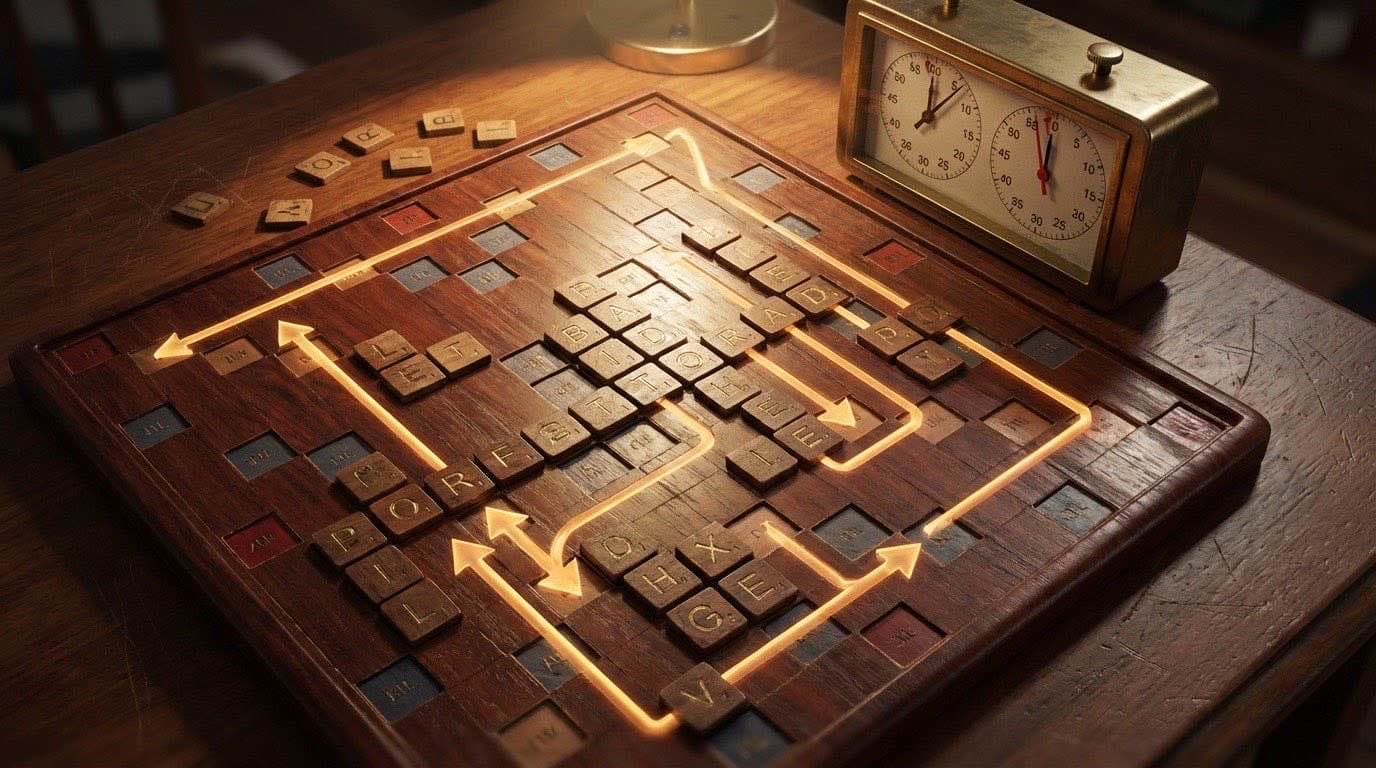
The explanation: experts don't remember individual pieces. They remember "chunks," clusters that form recognizable patterns. A pawn structure. A common opening. Their advantage isn't raw memory. It's pattern recognition built through thousands of hours of experience.
Word games work identically. When I look at a rack of letters, I see seven tiles. When Diane looks at the same rack, she sees letter clusters. UN-, RE-, -ING, -TION, QU, ZA. The board becomes a set of building blocks instead of isolated letters.
I tested this after the tournament. I started consciously looking for chunks instead of building words from scratch. The improvement was immediate. Not because I knew more words, but because I was processing information more efficiently.
Tile tracking: the skill nobody warns you about
Competitive players count tiles. Not metaphorically. They track which letters have been played and calculate what remains in the bag. By the endgame, top players know, with near certainty, what tiles their opponent is holding.
While you're trying to figure out if a word is valid, your opponent is running a mental inventory of 100 tiles and computing probability distributions.
At NASPA tournaments, tile tracking is considered basic. Not advanced. Basic. Players use a tracking sheet printed with all 100 tiles and cross them off as they're played. The mental math of knowing "there are two S's left and my opponent probably has one" fundamentally changes strategy.
I didn't track a single tile during my tournament games. Looking back, it's like I showed up to chess without knowing how the knight moves.
Speed and automaticity: the real edge
One more thing I noticed at the tournament: the top players play fast. Not recklessly fast. But decisively.
The moment their opponent places a tile, they're already thinking about their next move. They don't hem and haw. They calculate, they decide, they play. Five, six, seven seconds per turn.
This speed comes from automaticity. Pattern recognition becomes so ingrained that looking at a rack and finding valid words requires almost no conscious effort. The same way you recognize a friend's face without analyzing individual features. Your brain does the work beneath conscious awareness.
Research on expertise consistently shows that automaticity is the real marker of expert performance, more than IQ or raw processing speed. Expert players have offloaded so much word recognition to automatic processes that their conscious mind is freed up to think strategically about leave values, opponent psychology, clock management.
That speed also carries psychological weight. When you play quickly, you signal confidence. Your opponent senses it. And in a game where uncertainty and psychology matter, that's a real advantage.
Leave values: the math behind every strong turn
After the tournament I joined an online study group. This is where I learned about "leave values."
Every turn isn't just about the word you play. It's about the letters you keep. The tiles remaining on your rack have a calculable expected value based on probability and historical data.
A balanced mix of vowels and consonants is almost always better than all high-point tiles. An S is worth far more than one point because it can pluralize and hook onto existing words. A blank tile, worth zero points, is the most valuable tile because of its flexibility.
Top players have internalized these values. They'll sometimes play a lower-scoring word on purpose because it leaves better tiles. Sacrifice now, win later. It requires probabilistic reasoning that most casual players never consider.
I'd always evaluated turns by "how many points did I score?" Top players evaluate by "how many points did I score AND how good is my leave?" Completely different optimization problem.
Tournament pressure and the cognitive load
Tournament games use chess clocks, typically 25 minutes per player. Run out of time and you lose 10 points per minute. I watched a player who was clearly winning lose because he overthought his last three turns.
Clock management is brutal. But there's a deeper cognitive burden: holding tile probabilities, leave calculations, and strategic planning in working memory while under time pressure and staying emotionally balanced when the random draw goes against you.
The 14-year-old who beat me in my fifth game was kind about it. "You have a really good vocabulary," she said. "You just need to learn strategy." She'd been playing competitively since she was nine.
What casual players can steal from the pros
Here's what I took home:
1. Look for patterns, not complete words. Train yourself to see common letter combinations: prefixes, suffixes, two-letter words. Instead of trying to conjure whole words. The chunking research is clear: this is what separates experts from everyone else.
2. Your brain is already changing when you play. Visual word recognition improves with practice, even in adults. Every game rewires your neural pathways slightly. You don't need 4.5 hours a week of study to benefit. Consistency matters more than intensity.
3. Meaning is overrated for game purposes. If you're playing to win, learn which letter patterns are valid and move on.
4. Think about your leave. Even in casual play, paying attention to which tiles you keep dramatically improves scores. Don't dump all your good tiles for a flashy word if it leaves you with VVWK.
5. The gap between casual and competitive is enormous, and that's fine. Getting humbled is sometimes the most educational experience there is.
Visual word recognition keeps improving in adults. What looks like natural talent in expert players is almost always accumulated practice. Our brains are more flexible than we give them credit for.
Somewhere out there, Diane is practicing right now. And next time we meet across a tournament board, I'll be ready.

Ohad Fisher
Founder & Editor-in-Chief, LexiClash
Founder and editor-in-chief of LexiClash. 8+ years designing word games and reading cognitive-science research. Every claim in my articles is sourced and fact-checked against peer-reviewed studies — see our editorial policy.