
Versus
Boggle vs Words With Friends: One Is a Word Game, the Other Is a Waiting Game
Real-time grid chaos vs async tile placement. Which one actually respects your time (and your wallet)?
March 28, 20266 min read
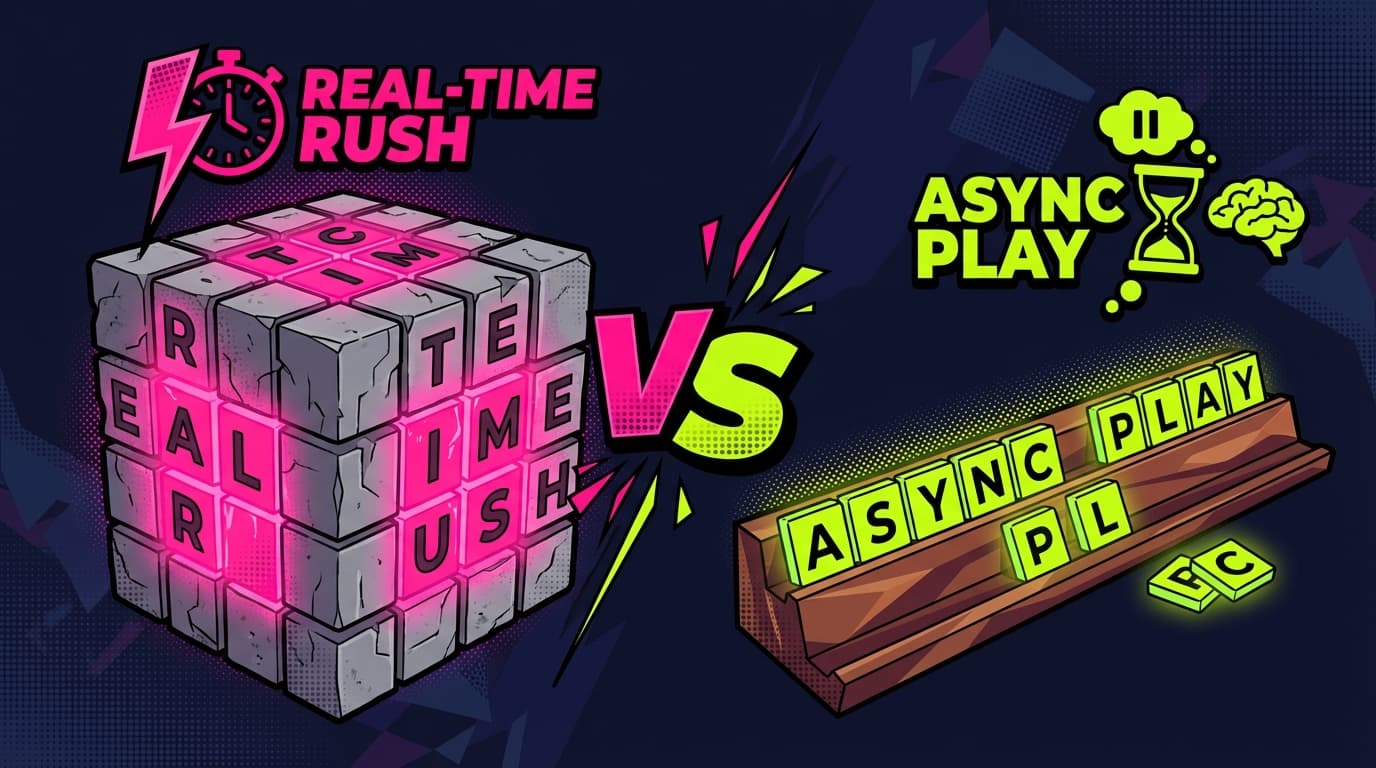
They're completely different games that share exactly one thing: letters.
That's like comparing Mario Kart to a road trip. Both involve driving. One makes you scream at friends in real time. The other takes four days and someone falls asleep.
I've sunk hundreds of hours into both. I have opinions. They're correct.
What is Boggle?
Real-time word-finding under pressure. You get a grid of random letters (4x4 or 5x5), a timer counts down, and you find as many words as possible by connecting adjacent letters. No turns. No waiting. Just you, the grid, and your rapidly deteriorating composure.
The magic is time pressure. You've got 2-3 minutes to scan, recognize patterns, and scribble down every word your brain can extract. It's pattern recognition on a deadline. Your brain shifts into a higher gear and suddenly you're seeing words you didn't know you knew. You're not overthinking QUARTZ or debating whether GRAT counts. You're in pure flow, your hands moving almost faster than your conscious thoughts.
The original Parker Brothers board game (1972, invented by Allan Turoff) used 16 dice in a plastic dome. Shake it, letters scatter randomly, everyone stares at the same grid. Digital versions like LexiClash keep this core loop intact: same grid, same timer, same beautiful panic. The difference: you're playing live against real people instead of polite silence around a wooden board.
What is Words With Friends?
Turn-based Scrabble with a different board layout and forgiving dictionary. You place tiles, score points based on letter values and bonus squares, then wait for your opponent's turn. And wait. And wait some more.
Words With Friends launched in 2009 by Zynga (acquired Newtoy Inc.), becoming the default phone word game because it nailed the asynchronous social angle. You could play with your aunt in Florida while pretending to work. One game stretches over days or weeks. Players develop traditions: morning move, evening move, forgetting for three days, random Sunday revival.
Core mechanic: tile placement and point optimization. You're not finding words under pressure. You're crafting the highest-scoring word from seven tiles, ideally on a triple-word square. You can spend twenty minutes staring at seven letters, rearranging them, checking the dictionary, second-guessing yourself. It's strategic, methodical, and rewards vocabulary depth and board vision over raw speed. Some players play a single game for months, grinding out 20-point moves. That's a different kind of satisfaction than the fist-pump of finding QUARTZ in two minutes.
Speed versus strategy
Boggle is a sprint. Words With Friends is chess played in slow motion.
In Boggle, you have 120 seconds. Your brain enters flow state where conscious thought takes a back seat and pure pattern recognition drives. It's almost athletic. No time to debate. No time to second-guess. Your hands move because you see the pattern, not because you calculated it.
Words With Friends gives unlimited time per turn. You can stare at tiles for twenty minutes, rearrange them, try different combinations. Check the dictionary. Uncheck it. Try again. It's deliberate. Occasionally tedious.
If you want adrenaline, Boggle wins. If you want to feel sophisticated pondering your next move over coffee, WWF has that vibe.
Personally? I want the adrenaline. Life is short.
Live multiplayer
Boggle multiplayer is alive in ways WWF never is. Everyone plays the same grid simultaneously. When the timer hits zero, you compare word lists. The tension of knowing someone else is finding words you're missing RIGHT NOW is what makes it addictive. LexiClash shows opponents' scores ticking up in real time. You see "Alex found 7" and your heart sinks because you missed the same obvious words. That social pressure is the entire game.
Words With Friends multiplayer is email with tiles. You move. Three hours later you get a notification. You move again. You forget about the game for two days. Your opponent nudges you with a gentle "Your turn!" reminder that makes you feel guilty. You move. They don't play for a week. You move again out of spite. Repeat for three weeks until someone wins by 12 points and both of you have moved on mentally.
I have seven active WWF games spanning three months. I care deeply about zero of them. I don't remember a single word from any of them. My last Boggle session on LexiClash? I still remember the winning word. QUARTZ on the final grid, diagonal cut across the board. My hands were shaking. That's what a word game should feel like: memorable enough to replay in your head an hour later.
The monetization problem
Boggle-style games have traditionally been simple. Grid, timer, words, done. LexiClash is completely free with no pay-to-win mechanics. You win because you found more words, period.
Words With Friends 2 got creative. "Word Radar" highlights the best available word on the board (cheating without cheating). "Swap+" lets you exchange tiles without losing your turn (which is normally your cost-benefit trade-off). "Hindsight" shows you all the words you missed after you move. All purchasable. All giving paying players direct competitive advantage.
If your opponent can spend $4.99 to see the optimal move and you can't, that's not a game anymore. That's an auction where one person brought more money.
The App Store reviews confirm it. Thousands of variations on the same complaint: "Pay to win ruined this game." "I can't compete unless I buy power-ups." "My opponent clearly paid for Word Radar. I can tell because they played the exact word I didn't see." Real players, real frustration.
Boggle's purity is its greatest feature. The grid doesn't care about your credit card. It doesn't know you have a premium subscription. Either you see the words or you don't. That's it. LexiClash keeps it that way: no power-ups, no boosts, no "premium hints" or "VIP grid advantages." Just letters and your brain. That's not a marketing constraint. That's intentional design.
Which is actually more fun?
Boggle is more fun. There. Said it.
The time pressure creates moments Words With Friends simply cannot replicate. The last-second discovery of a seven-letter word you almost missed. The agonizing near-miss when the timer hits zero and you were one swipe away from FANTASTIC. The dopamine hit when you clear the grid and your score explodes. These moments stick with you.
Words With Friends has pleasant moments. Landing a 50+ point word on a triple square is intellectually satisfying. But it's slow, mild satisfaction. Like completing a difficult crossword puzzle instead of winning a race. You take a sip of coffee. You feel quietly clever. Then you close the app and forget it happened.
Both are legitimate. They satisfy different moods. If you're waiting in line at the DMV and want entertainment, Words With Friends works. If you want a game that makes your hands shake and your heart rate spike, you want Boggle.
LexiClash combines Boggle's real-time intensity with modern features. Adventure Mode (single-player story campaign). Daily challenges (new grid every day, leaderboards). Multiplayer rooms where you see live scores tick up. No pay-to-win. No power-ups. No "premium hints." Just the pure game, polished and fast.
Brain training?
Let's be honest. Playing word games won't cure dementia or make you a genius. If someone claims a word game will prevent Alzheimer's, they're either mistaken or selling something.
What we do know: timed word-finding activates more neural pathways than untimed tile placement. Your brain has to work faster, make connections quicker, scan patterns under stress. That's measurably different from leisurely strategic play.
For vocabulary building, both help. But Boggle also trains processing speed and visual scanning. You're building reflexes, not just knowledge.
Is it brain training? Not in the "prevent dementia" sense. Is it a good cognitive workout? Yes. Is it more engaging than scrolling social media for twenty minutes? Absolutely. That's enough.
FAQ
Is Boggle harder than Words With Friends? Different kind of hard. Boggle tests speed and pattern recognition under pressure. WWF tests vocabulary depth and strategic placement.
Can you play Boggle online for free? Yes. LexiClash is free, no downloads, no pay-to-win, real-time multiplayer, daily challenges.
Is Words With Friends pay-to-win? Effectively, yes. Word Radar and Swap+ give paying players a direct edge.
Which is better for your brain? Timed word-finding activates more neural pathways than untimed tile placement. Both help vocabulary, but Boggle trains processing speed and visual scanning.
Can I play both? Obviously. But if you have to pick one, pick the one that doesn't charge you to compete fairly.

Ohad Fisher
Founder & Editor-in-Chief, LexiClash
Founder and editor-in-chief of LexiClash. 8+ years designing word games and reading cognitive-science research. Every claim in my articles is sourced and fact-checked against peer-reviewed studies — see our editorial policy.