
Comparison
Boggle vs Wordle: Which Word Game Actually Deserves Your Time?
An honest head-to-head from someone who plays both every single day.
March 28, 20266 min read
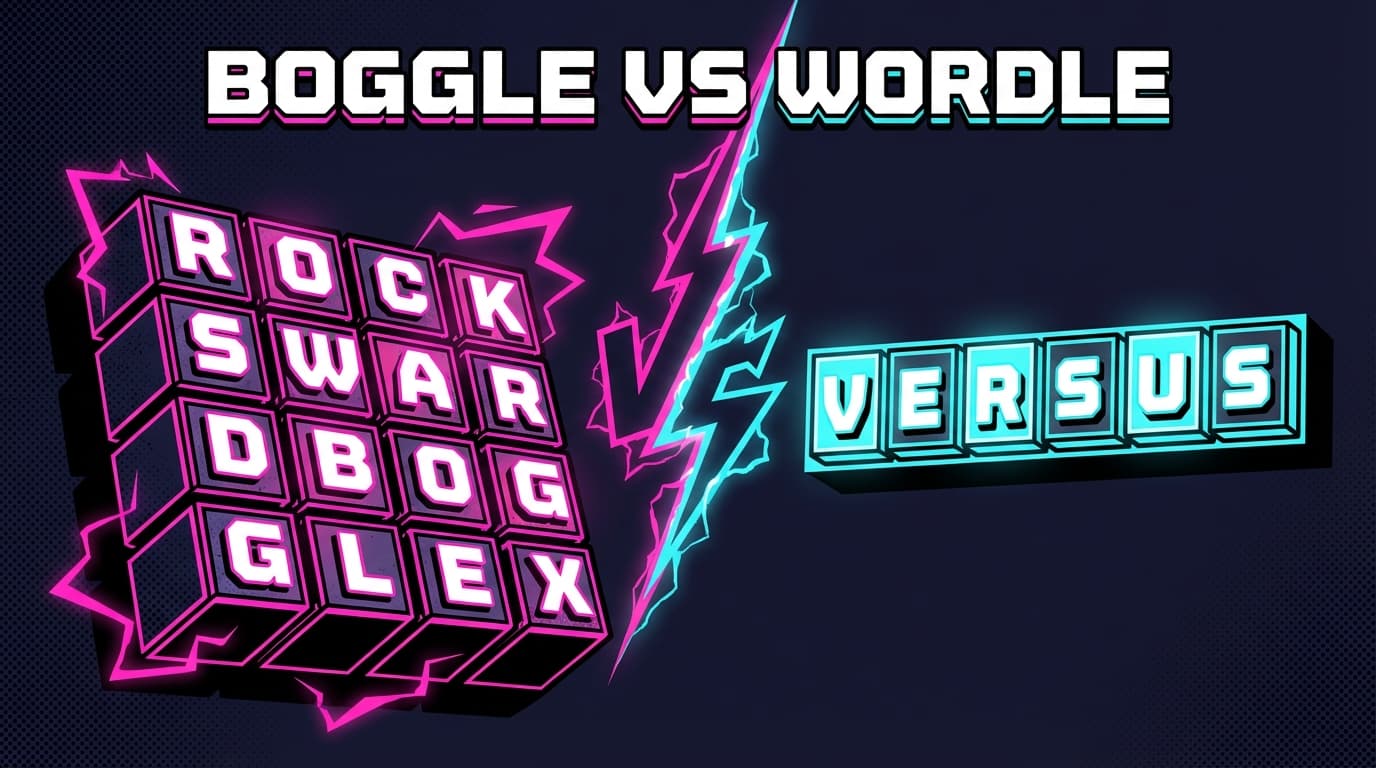
Let me settle this once and for all.
Every week someone asks me "should I play Boggle or Wordle?" and every week I resist the urge to write a 3,000-word essay in response. Today I'm giving in.
The thing is: comparing Boggle and Wordle is like comparing tennis and golf. Both involve skill. Both are satisfying. But they scratch completely different itches, and the people who love one don't always love the other. I happen to love both, which puts me in a position to actually answer this question instead of just pick a team.
How they work
Boggle is a 4x4 grid (sometimes 5x5) of random letters. You have 3 minutes to find as many words as possible by connecting adjacent letters — including diagonals. You can't reuse the same letter cube in one word. The scanning is what kills you: your eyes dart across the grid, suddenly you see QUARTZ hiding in the corner, and you feel like a genius. For about two seconds, until the timer runs out and you realize you missed PIZZA.
Wordle gives you six attempts to guess a five-letter word. After each guess, letters turn green (right letter, right spot), yellow (right letter, wrong spot), or gray (not in the word). One puzzle per day. Everyone gets the same word. The genius isn't the mechanic — it's the constraint. One puzzle. You either solved it or you didn't. No practice mode. No do-overs. That emotional weight from a free browser game is the actual product.
The key differences
Speed vs patience. Boggle is a 3-minute sprint of pure adrenaline. Wordle is a slow burn — could be solved in 30 seconds or consume 15 minutes of staring at your phone muttering "what five-letter word has a T and an R but not an E?" The pacing fundamentally shapes how your brain engages with each game.
Finding vs guessing. In Boggle, the words are already on the board. You just have to see them. Your job is perceptual — pattern matching at speed. In Wordle, the word is hidden. You have to deduce it through systematic elimination, testing hypotheses with each guess. One is about visual scanning. The other is about reasoning.
Many vs one. Boggle asks "how many can you find?" Wordle asks "can you find THE one?" Quantity versus singular precision.
Real-time vs solo. Boggle (especially online versions) is competitive chaos — you're racing against other humans on the same board, watching their scores tick up in real time. Wordle is you vs the puzzle, a private duel. One is a party. The other is meditation.
Replayability. You can play Boggle fifty times a day. Wordle gives you exactly one puzzle every 24 hours. Boggle is all-you-can-eat buffet. Wordle is omakase — one course, take it or leave it.
When Wordle wins
The social element is unmatched. That emoji grid you share with friends — no spoilers, just colored squares — transformed a solo puzzle into a shared cultural moment. My group chat has been trading Wordle scores daily since 2022. Four years. Nothing else has that staying power. You can't get that from Boggle; competitive scores don't translate to emoji bragging rights the same way.
Wordle is also the perfect daily ritual. Quick, satisfying, done. You fit it between your coffee and the first meeting. The constraint creates genuine stakes. When you solve it in two guesses, you genuinely feel something. When you fail, it stings until tomorrow. That emotional swing from a free game is remarkable — you're not chasing points or combos, you're hunting one word, and the binary pass/fail hits different.
But here's where Wordle hits its ceiling: the skill bar is real. Most players reach the top in a few months. After that, you're repeating the same opening strategy with different words. There's a reason Wordle fans stay loyal — it doesn't overstay its welcome.
When Boggle wins
Boggle is a much deeper game. A casual player finds 15-20 words in three minutes. A competitive player finds 60-80. That gap represents hundreds of hours of spatial scanning development, vocabulary expansion, training your brain to spot seven-letter words hiding in plain sight. There's no cap. The best Boggle players operate in a different dimension.
Boggle also has the competitive edge Wordle completely lacks. When you're playing against another human in real time and you both see the same word in the same instant — that electrical moment is something Wordle can't touch. Wordle gives you a score. Boggle gives you a rival.
Variety matters too. Every Boggle board is genuinely different. Some boards are generous — vowels everywhere, common letter patterns. Others are brutal consonant clusters that punish you for every word choice. Wordle's daily word is fixed; your opening strategy is nearly identical every single time.
The time commitment works in Boggle's favor if you need more than 3 minutes of daily brain work. You can play five rounds or fifty. It scales with your appetite and available mental energy — Wordle is take-it-or-leave-it.
The honest truth
Here's what nobody in the Boggle-vs-Wordle debate wants to admit: these games don't compete with each other. They're not fighting for your attention — they're fighting for different moments in your brain.
Wordle is a daily ritual. Brain hygiene. Brushing your teeth for your mind. It's the thing you do because you do it, and it works.
Boggle is a hobby. It's the gym for your brain. You go when you have time, you push yourself, you improve over weeks and months. It's optional until it isn't — until you realize you're playing fifty rounds a day.
The real question isn't "which is better?" It's "what do you want right now?" Most people's answer changes depending on the day. Tuesday morning commute? Wordle — three minutes, done. Saturday night with friends? Boggle — competitive, social, replayable. Wednesday at 2 AM when you can't sleep? Also Boggle, apparently. That's when you discover whether you're a Wordle person or a Boggle person, or both.
I play both. Every single day. Wordle first thing — it takes three minutes and warms up the brain. Then I open LexiClash, which is where I get the deeper Boggle-style stuff: the daily challenges, the competitive multiplayer, the progression system that actually rewards time invested. Wordle is the appetizer. LexiClash is the meal. The two don't step on each other at all.
What about the alternatives?
Both games have spawned variants. Wordle clones like Quordle (four puzzles at once for masochists) and Connections (NYT's categorization spin) exist, but Wordle's simplicity is its strength. Nobody wants a complicated Wordle.
Boggle alternatives are different. Word Blitz is fast but thin. LexiClash (full disclosure: the one I play daily) takes the Boggle formula and adds boss battles, daily challenges, multiplayer lobbies, and a progression system that actually keeps me coming back. The reason Boggle-style games have room to grow is that players want depth beyond pure word-finding. Wordle proved people want constraints. Boggle games prove people want complexity once they're hooked.
Final take
If you're only going to play one word game — which seems unnecessarily limiting — pick based on who you are.
If you want elegance, ritual, and a shared cultural moment: Wordle. Forever Wordle. It doesn't need to evolve. Its genius is that it does exactly one thing and does it perfectly.
If you want depth, competition, and the electric thrill of finding a word nobody else found: Boggle. Specifically a modern version that doesn't nickel-and-dime you with power-ups.
If you're like me and want both: Wordle in the morning for your coffee routine, then Boggle-style games for everything else. That's been my daily rhythm for months and I have zero plans to change it. The two games coexist peacefully in that schedule because they want different things from you.
The best word game is the one that makes you feel something when you find a great word. Both do that. Just in entirely different ways.
Now go play something. Your brain will thank you. Your productivity won't, but your brain will.
Ohad Fisher
Founder & Editor-in-Chief, LexiClash
Founder and editor-in-chief of LexiClash. 8+ years designing word games and reading cognitive-science research. Every claim in my articles is sourced and fact-checked against peer-reviewed studies — see our editorial policy.