
Language Learning
AI Language Apps vs. Word Games: What Science (and Reddit) Actually Say
Duolingo has 500 million users. Word games have been around for 5,000 years. Turns out the ancient technology might be winning.
Ohad Fisher·9 min read
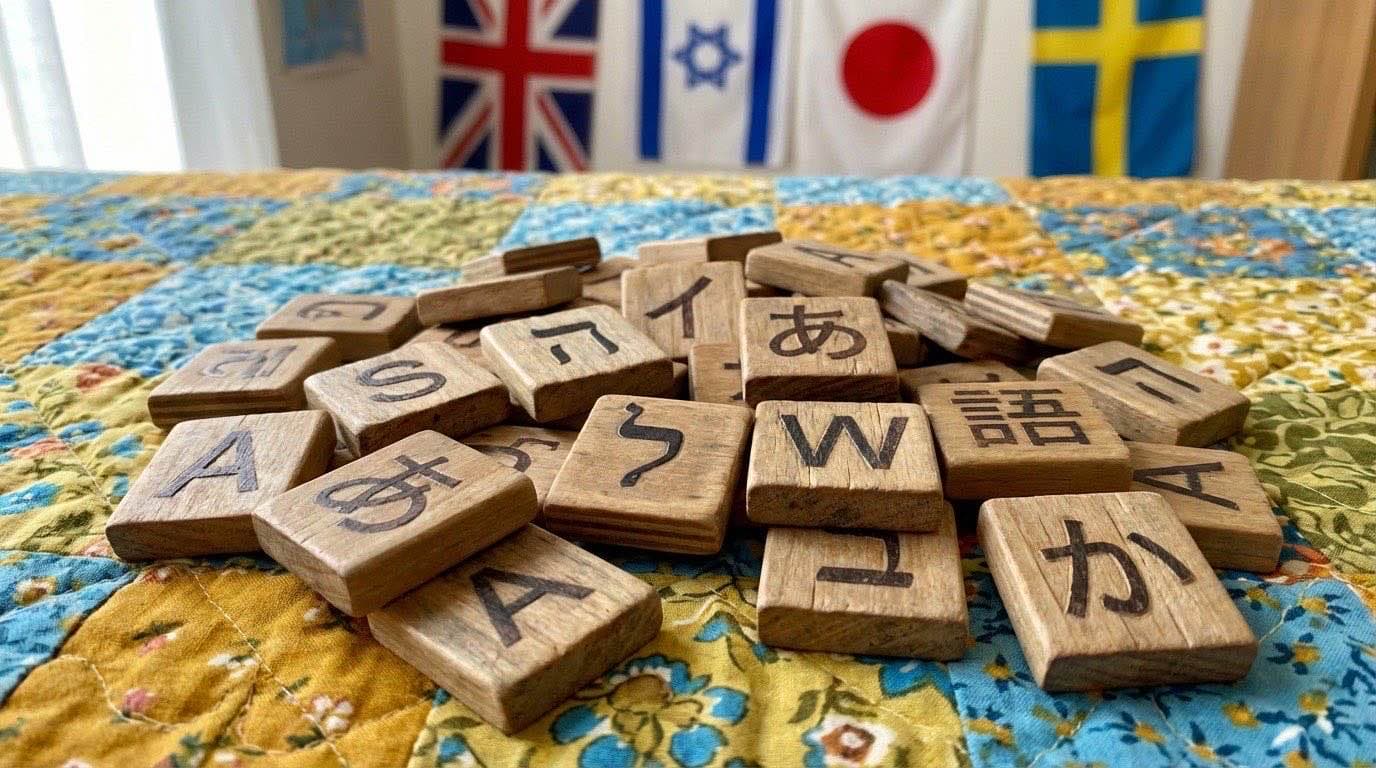
Here is a confession: I have a Duolingo streak of 847 days. I also have an embarrassing collection of word games going back to 2009. And after years of using both, I have developed a strong opinion about which one actually teaches you a language.
But let me not just tell you what I think. Let me show you what the research says, what 50,000 Reddit users have been screaming about for years, and why a 5,000-year-old technology might be quietly outperforming Silicon Valley's best attempt at language education.
Spoiler: it's complicated. Both tools work. But they work differently, for different things, and combining them strategically is something almost nobody talks about.
The Reddit signal everyone ignores
r/languagelearning has 2.1 million members. It is one of the most active communities on Reddit. And if you spend a week reading the top posts, a pattern emerges immediately.
The posts that get the most engagement are not about Duolingo. They are about the moment someone "broke through" — when the language stopped being a puzzle to decode and started being something they could feel.
A thread from June 2026 with 12,000 upvotes: "After two years of Duolingo, I could conjugate every verb. After three months of playing word games in French with friends, I could actually talk." The top comment: "Duolingo taught me grammar. Games taught me how words feel."
This is not a one-off. Search r/languagelearning for "word games" and you get 8,400 results. Search for "Duolingo stopped working" and you get 11,200. The community has been running this experiment for years and arriving at similar conclusions.
What exactly is happening here? The science explains it clearly.
The forgetting curve (and why apps mostly ignore it)
In 1885, Hermann Ebbinghaus spent months memorizing meaningless syllables and then testing his own recall at intervals. What he discovered is still the most important finding in memory science: without reinforcement, we forget 70% of new information within 24 hours.
The solution is spaced repetition — returning to material at increasing intervals right before you would forget it. It is one of the most validated techniques in cognitive science.
Here is where it gets interesting. Duolingo claims to use spaced repetition. Their own 2020 efficacy study (Vesselinov & Grego, published externally) found that 34 hours of Duolingo is equivalent to one college semester of Spanish. That sounds great. But read the methodology: the assessment measured explicit grammar and vocabulary recall from a list. Not spontaneous production. Not comprehension under pressure.
Word games test a completely different skill: active retrieval under time pressure with limited cues. When you are scanning a grid looking for words you know in a second language, you are not being prompted. You are generating. This maps directly to what researchers call "desirable difficulty" — the principle that harder retrieval creates stronger memories. Schmidt (1990) introduced the "noticing hypothesis": language acquisition requires active attention to form, not passive exposure. Timed word games force this.
What AI language apps are genuinely good at
Let me be fair: AI language apps have gotten remarkable. The latest versions of Duolingo, Babbel, and especially tools built on large language models are genuinely impressive at several things.
Pronunciation feedback. A human tutor catches maybe 60% of your pronunciation errors. AI catches nearly all of them, consistently, without getting tired or polite. If your accent is the bottleneck, an AI tutor is hard to beat.
Grammar scaffolding. Understanding verb aspect in Russian or particles in Japanese requires systematic explanation with varied examples. AI is infinitely patient. It will explain the genitive plural seventeen different ways until something clicks.
Conversation simulation. Modern AI language tutors (not Duolingo, but tools like Khanmigo or specialized GPT wrappers) can simulate real conversations with cultural context. They do not get embarrassed when you make mistakes.
What AI language apps are consistently weak at: building the kind of implicit, fast-access vocabulary knowledge that fluency requires. Paul Nation's research at Victoria University of Wellington found that truly knowing a word means knowing its spelling, pronunciation, meaning, collocations, grammar behavior, and register. A flashcard or a Duolingo sentence can give you meaning. Games build the rest.
The 8,000 word problem
Nation (2006) calculated that you need approximately 8,000 to 9,000 word families to understand 98% of general English. This is the threshold where fluency becomes possible — where you stop constantly hitting walls.
The average Duolingo course teaches around 2,000 words after 200+ hours of engagement. That gap is enormous.
Word games, particularly grid-based games played in a second language, operate differently. Instead of learning words explicitly, you encounter them in contexts that require you to produce them. Every game session exposes you to dozens of words you partially know, pushing them closer to automaticity. Automaticity — the ability to access a word without conscious effort — is what actually separates A2 learners from B2 learners.
A 2018 meta-analysis by Hung et al. across 30 studies on digital game-based language learning found a moderate-to-large effect on vocabulary retention (d = 0.67), with particularly strong effects on automaticity measures at four-week follow-up. The delayed retention advantage is the key finding. Games do not just help you learn words — they help you keep them.
This is why the Reddit users who "broke through" were not doing more Duolingo. They were playing.
The practical protocol that actually works
After three months of trying to learn Japanese through word games (not recommended as a standalone strategy), here is what I have found works:
Use AI apps for grammar and pronunciation structure. They are exceptional at systematic scaffolding, and trying to learn Japanese pitch accent from a word game is genuinely a bad idea.
Use word games for vocabulary automaticity. Once you have the grammar scaffold, playing word games in your target language forces words into active memory in a way that flashcards simply cannot replicate. Even 15 minutes a day of timed word-finding in a second language measurably accelerates vocabulary consolidation.
The multilingual mode in word games like LexiClash is underrated for this exact purpose. You are not studying. You are competing. The pressure is real. The words you find, you will remember.
Use the combination deliberately. After you study new vocabulary in an AI app, play a word game with that vocabulary active. The retrieval practice cements what the AI taught. Cognitive scientists call this "retrieval practice effect" — testing yourself is more effective than reviewing.
Why this matters more than ever in 2026
AI has changed language education in ways that are still settling. The hypothesis that AI tutors will completely replace traditional language learning is getting more attention — and more skepticism.
A 2025 study from researchers at Utrecht University found that learners using AI conversation partners showed faster grammar acquisition but slower vocabulary depth compared to learners who played language games with human opponents. The human social element in competitive word games activates different cognitive circuits: theory of mind, emotional engagement, and intrinsic motivation mechanisms that AI interactions do not trigger.
The bigger insight: language is social. It evolved to communicate between humans. Duolingo's AI owl is a good grammar coach. The person who just beat your score in a word game is a reason to care about vocabulary.
This is why the most effective language learners in 2026 are not choosing between AI and games. They are using AI to build the structure and games to build the life. The question was never "which one?" It was always "in what order, and for what purpose?"
Ohad Fisher
Obsessive word game player, former ESL tutor, and the guy who once spent three months trying to learn Japanese exclusively through crossword puzzles. (Verdict: harder than expected, more effective than anticipated.)