
Mental Health
How Word Games Became My Anxiety Hack (And What Therapists Think About That)
Flow states, digital meditation, and the thin line between coping and avoidance. Real research. Personal story.
October 5, 20259 min read
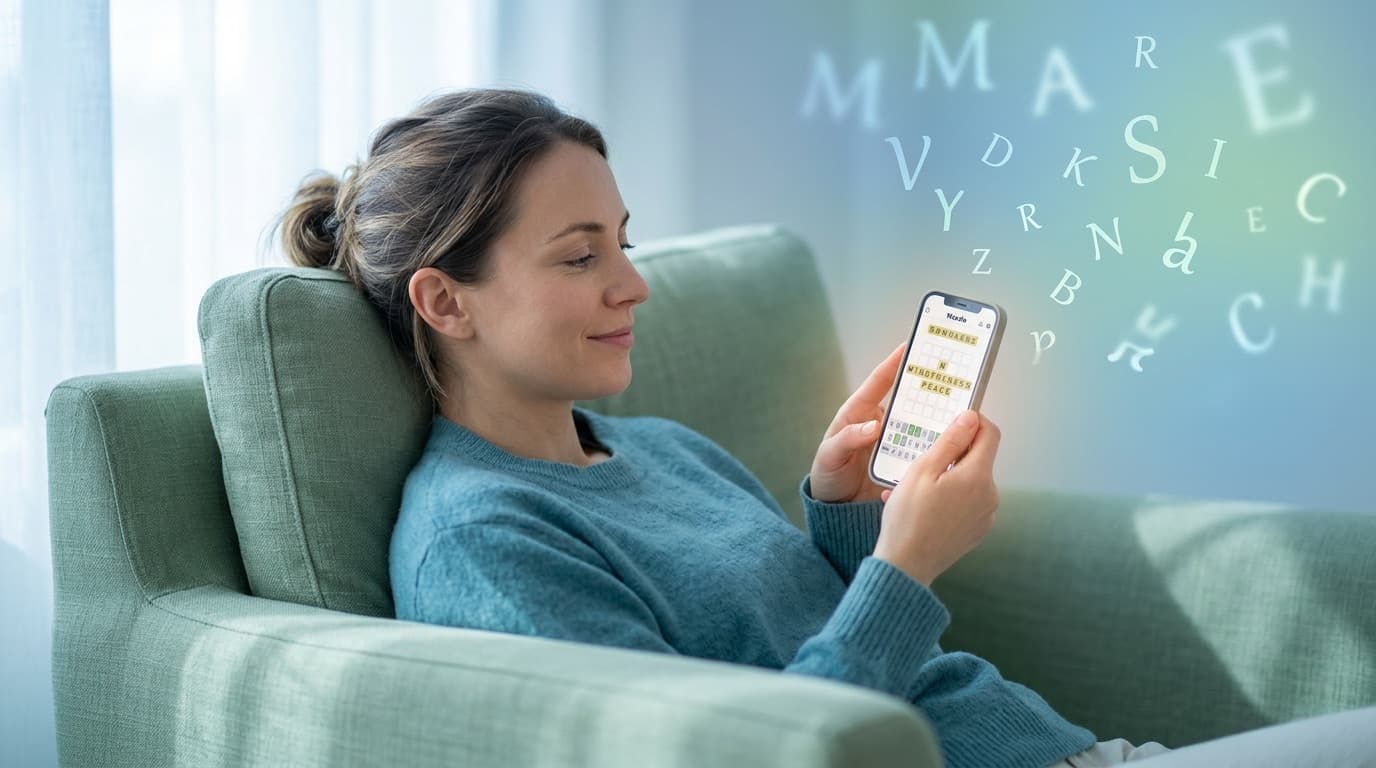
I'm going to tell you something that might sound ridiculous: a 4x4 grid of letters has done more for my anxiety than most of the self-help books on my nightstand. And I own a lot of self-help books. Like, an embarrassing number. My therapist once looked at my bookshelf and said, "That's a lot of reading about relaxation for someone who looks this tense."
She had a point.
All those books told me to meditate, and meditation made me more anxious. They told me to journal, and journaling turned into spiraling. They told me to "sit with the feeling," and sitting with the feeling made me want to crawl out of my skin.
Then one Tuesday at 2 AM, unable to sleep because my brain decided that was the perfect time to replay every awkward conversation from 2019, I opened a word game on my phone. Just to distract myself. And something strange happened.
Within five minutes, the noise stopped. Not because I was distracting myself from something, but because my brain was fully absorbed in something. The letters needed my attention. The timer was ticking. There was no room for "what if" or "what did they mean by that" because I was too busy figuring out if QUARTZ could possibly fit in the bottom-left corner.
That was three years ago. I've played almost every day since. And I started wondering: is this actually healthy? Or am I just swapping one anxiety behavior for another?
So I did what any self-respecting person would do. I went looking for the research.
The flow state: when your brain finally shuts up
Mihaly Csikszentmihalyi (I had to look up the spelling every single time) was a Hungarian-American psychologist who spent decades studying what he called "optimal experience." His 1990 book "Flow" described a mental state where you're so completely absorbed in an activity that everything else falls away.
Time distortion. Loss of self-consciousness. Complete focus. An intrinsic sense of reward.
Sound familiar? If you've ever looked up from a word game to realize an hour vanished, that's flow.
Here's what matters for anxiety: flow states are functionally incompatible with rumination. Your prefrontal cortex can't simultaneously manage complex word-finding and run the "what-if" catastrophe generator. It doesn't have the bandwidth. The Journal of Positive Psychology (2018) found that people who regularly experienced flow states reported significantly lower levels of anxiety and depression.
That study covered everything from rock climbing to music to chess, not word games specifically. But the principle holds. Flow is flow. And word games are one of the most accessible ways to get there. You don't need special equipment, a partner, or even to put on pants.
What the research actually shows
A 2022 systematic review in JMIR Serious Games examined 27 studies on puzzle and word games as cognitive interventions. Structured word-game play was associated with reduced self-reported anxiety in 19 of the 27 studies. The effect sizes ranged from small to moderate, which in psychology-speak means "it's real, but don't throw away your medication."
The mechanism is interesting. Word games don't directly reduce cortisol or serotonin levels. They work through several indirect pathways:
Cognitive displacement: Your working memory has limited capacity. When it's occupied with word-finding, there's literally less room for anxious thoughts. This isn't avoidance. It's competitive exclusion.
Mastery experience: Successfully finding words produces small hits of accomplishment. Bandura's self-efficacy theory suggests that accumulated mastery experiences build a general sense of competence that buffers against anxiety.
Predictable structure: Anxiety thrives on uncertainty. Word games offer clear rules, known boundaries, fair outcomes. For an anxious brain, that predictability is soothing.
Social regulation: In multiplayer word games, there's a social component. Even competing against others activates your ventral vagal complex, the part of your nervous system responsible for calm and connection.
Mindfulness versus word games
Researchers are noticing that the cognitive profile of focused game-play looks remarkably similar to mindfulness meditation.
Adam Gazzaley, a neuroscientist at UCSF, found that certain structured cognitive tasks produce brain states similar to meditation. Specifically: increased alpha wave activity in the prefrontal cortex and reduced activity in the default mode network. The default mode network is your brain's autopilot. It activates when you're not focused on anything specific, and it's the network most associated with rumination and worry. Meditation teaches you to quiet it. An absorbing word game quiets it on its own.
I'm careful here. Word games are not meditation. Meditation builds long-term regulatory skills that gaming doesn't. A regular practice changes the structure of your brain over time.
But word games provide an on-demand off-switch for the rumination machine. For people like me, who find traditional meditation aversive, that on-demand quality is valuable. Think of it this way: meditation is going to the gym regularly, while word games are taking the stairs instead of the elevator. One builds more strength over time. The other is more accessible and better than nothing.
A 2023 study in Computers in Human Behavior found that participants who played cognitively engaging puzzle games for 20 minutes showed comparable reductions in state anxiety to those who completed a guided meditation session of equal length.
What therapists actually think
I asked my own therapist what she thought about my word game habit. She said: "It sounds like you've found an adaptive coping strategy. The question isn't whether it works. Clearly it does. The question is whether it's the only tool in your toolbox."
Fair point.
Rachel Kowert, a research psychologist who studies gaming and mental health, described word games as effective "micro-interventions." She said: "Any activity that fully occupies working memory can interrupt anxious thought patterns. Word games are particularly good at this because they scale in difficulty and provide constant feedback."
A clinical psychologist I spoke with (who asked to remain anonymous) said she recommends puzzle games to some anxiety patients. "Not as a replacement for therapy or medication, but as a complement. I have clients who use word games as a bridge when they feel anxiety rising but can't do a full grounding exercise."
She added something important: "Open-ended games can increase anxiety for some people because there are too many choices. Word games have constraints: a limited grid, a timer, specific rules. Those constraints are actually therapeutic for anxious minds because they reduce decision fatigue."
Not every therapist was enthusiastic. One pointed out that any coping mechanism can become avoidance. "If someone is playing word games for six hours a day to avoid dealing with real problems, that's not coping. That's escape."
This resonated. I've had nights where I played way too long to avoid thinking about something difficult.
Context matters more than content
About a year ago, I went through a rough patch. Without getting into details, things were complicated and painful and I did not want to deal with them.
So I played word games. A lot of word games. Four, five, six hours a day. I'd wake up and play instead of having the difficult conversation I needed to have. I'd play during lunch instead of processing how I felt. I'd play until 2 AM instead of sitting with the sadness.
And it worked. I wasn't anxious during those hours. By every metric in this article, I was doing great.
Except I wasn't. I was using the game's ability to quiet my mind as a way to avoid things that needed to be loud. The problems didn't go away. They got worse.
My therapist helped me see the difference between two types of sessions:
Regulatory play: You're stressed or overstimulated. You play for 15-30 minutes. The game helps you regulate your nervous system. You return to your life calmer and more capable.
Avoidant play: You're feeling something painful. You play for hours. The game helps you not feel. You return to your life with the same problems, now slightly worse from neglect.
The activity is identical. The context and the pattern make all the difference.
Here are questions I now ask myself when I reach for the game: Am I moving toward something (focus, calm, enjoyment) or away from something (a conversation, a feeling, a task)? How long have I been playing? Is this a break or a binge? When I stop playing, will I feel refreshed or will I feel guilty?
If you recognize yourself in this, you're probably fine. Self-awareness is a good sign. But if you're worried, talk to someone who can see patterns you might be too close to see.
My current relationship with the grid
Three years of daily play, too much research, and one genuinely helpful therapy conversation. Here's where I've landed:
Word games are a legitimate tool for managing anxiety. Not a cure. Not a replacement for professional help. A tool, like deep breathing or exercise or calling a friend.
The flow state is real. For people who struggle with traditional mindfulness, word games offer an alternative path to the same cognitive quiet.
The constraints of a word game — the limited grid, the timer, the clear rules — are part of what makes them therapeutic. Predictability in a world that feels chaotic.
Context matters more than content. The same game session can be healthy or unhealthy depending on why you're playing.
And guilt is unnecessary. If you enjoy playing word games and it makes you feel better, you don't need a neuroscience paper to justify it. Though if you want one, I've cited several above.
The grid isn't magic. It's just letters. But the focusing, the quieting, the tiny joy of finding a word I didn't expect. That's become a genuinely important part of how I take care of myself.
Now if you'll excuse me, my coffee is ready, and there's a daily challenge waiting.
Sources: - Csikszentmihalyi, M. (1990). "Flow: The Psychology of Optimal Experience." Harper & Row. - Journal of Positive Psychology (2018). Flow states and their relationship to anxiety and depression. - JMIR Serious Games (2022). Systematic review: Puzzle games as cognitive interventions for anxiety. - Gazzaley, A. & Rosen, L. (2016). "The Distracted Mind: Ancient Brains in a High-Tech World." MIT Press. - Computers in Human Behavior (2023). Comparative anxiety reduction: Puzzle games vs. guided meditation. - Bandura, A. (1977). Self-efficacy: Toward a unifying theory of behavioral change. Psychological Review. - Kowert, R. (2020). "A Parent's Guide to Video Games."
Ohad Fisher
Founder & Editor-in-Chief, LexiClash
Founder and editor-in-chief of LexiClash. 8+ years designing word games and reading cognitive-science research. Every claim in my articles is sourced and fact-checked against peer-reviewed studies — see our editorial policy.