
History
From Ancient Tiles to Digital Grids: The Wild History of Word Games
Stolen ideas, crossword mania, a stay-at-home dad's invention, and one five-letter word that broke the internet.
January 8, 20266 min read
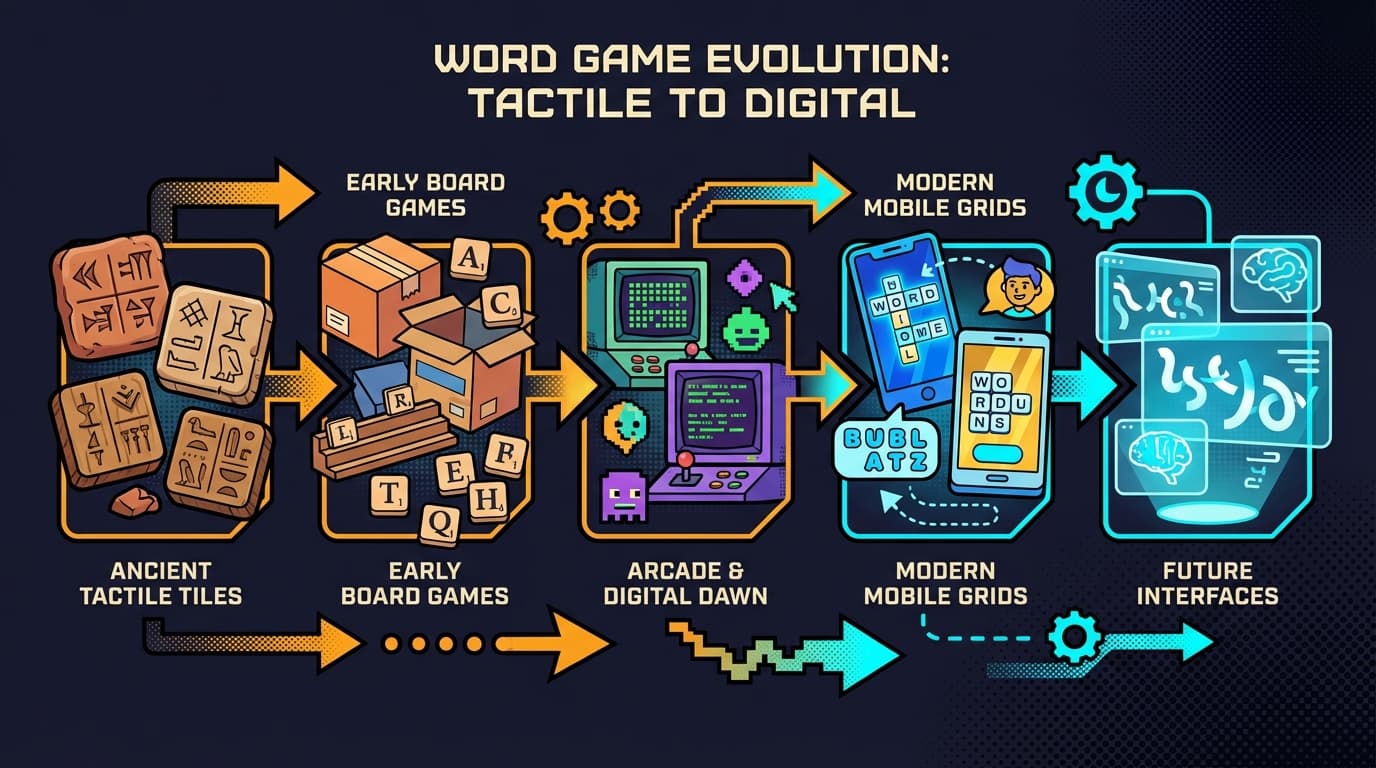
I own a replica of a Roman wax tablet. It sits on my desk next to my monitor, right below the sticky note that says "REMEMBER TO EAT LUNCH." I bought it because Roman schoolchildren practiced word games on these things almost two thousand years ago, and that felt like the coolest thing I'd ever heard.
My partner thinks I need an intervention. She's probably right.
But here's the thing: the history of word games is genuinely one of the wildest stories in human culture. Ancient Egyptian riddles. Medieval monks with too much free time. A bitter IP dispute that tore apart friendships. A newspaper craze that got people fired. A Welsh software engineer who accidentally created a global phenomenon during lockdown.
Word games have been making us slightly unhinged for four thousand years.
Ancient origins: when words were magic
The oldest known word games date back roughly four thousand years, and they weren't played for fun. They were genuinely believed to have magical power.
The ancient Egyptians were obsessed with wordplay. The Leiden Papyrus, dating to around 1200 BCE, contains riddles and word puzzles that scribes used to test each other. In Egyptian culture, knowing the "true name" of something gave you power over it. Word mastery was literally a form of magic.
The Greeks invented the acrostic, poems where the first letters of each line spell out a word or message. The Romans were particularly fond of word squares, grids where the same words read both horizontally and vertically. The most famous is the SATOR Square, found scratched into walls across the Roman Empire from Pompeii to Manchester. It reads SATOR AREPO TENET OPERA ROTAS, and scholars have been arguing about what it means for centuries. Some think it's a Christian prayer encoded to avoid persecution. Others think it's just an ancient Roman doodling in the margins during a boring meeting.
I like to think about those Roman soldiers scratching word puzzles into stone walls while waiting for something to happen. People have always needed something to do with their brains during downtime. We're not so different.
The Scrabble story: genius, theft, or both?
Alfred Mosher Butts spent months analyzing the front pages of The New York Times, counting letter frequencies by hand. It was 1933. The Great Depression had gutted the construction industry, and Butts, an unemployed architect, needed something to do.
He created "Lexiko," then refined it into "Criss-Crosswords" — essentially Scrabble. Same letter tiles, same board, same scoring system. Nobody wanted it. Parker Brothers rejected it. Milton Bradley rejected it. Every major game company said no.
Then James Brunot came along. In 1948, he bought the rights, simplified the rules, changed the name to "Scrabble," and started manufacturing sets in his living room. For the first few years it barely sold. But then, in 1952, the president of Macy's played Scrabble on vacation and loved it. He ordered sets for all Macy's stores. Sales exploded. Within two years, Scrabble was selling millions of copies.
Butts, the inventor, received royalties. Brunot became wealthy. It's a pattern we'll see again: the creators rarely capture the value they create.
The crossword craze (1920s viral)
The first crossword puzzle appeared on December 21, 1913, in the New York World newspaper. It was created by Arthur Wynne, a journalist from Liverpool, and it was diamond-shaped. Wynne called it a "Word-Cross."
For about ten years, crosswords were a minor newspaper feature. Then, in 1924, two young publishers named Richard Simon and M. Lincoln Schuster had an idea. Simon's aunt was a crossword fan and couldn't find a book of them. So Simon and Schuster published one. Their very first book as a brand-new publishing company.
What happened next was one of the first viral phenomena in American media history. The book sold over 350,000 copies in its first year. Crossword puzzle books became the hottest gift in America. Newspapers that didn't run crosswords started losing subscribers. The New York Times, which would eventually become synonymous with crosswords, initially refused to run them, calling them "a primitive form of mental exercise" in a snooty 1924 editorial.
Employers complained that workers were doing crosswords instead of working. The Baltimore and Ohio Railroad put dictionaries on all its trains because passengers kept arguing about spellings. A Chicago woman sued her husband for divorce because he was "a crossword puzzle addict" who wouldn't talk to her.
Libraries reported that dictionaries were being stolen. Not borrowed. Stolen. People were cutting pages out of reference books to settle crossword disputes.
This is what word games do to people. The 1920s crossword craze looked remarkably like the 2022 Wordle phenomenon: global obsession, workplace distraction, shared experience.
Boggle and the speed revolution
In 1972, toy inventor Allan Turoff created something that fundamentally changed how word games work. His insight was brilliantly simple: what if, instead of taking turns, everyone played at the same time? What if the challenge wasn't just vocabulary, but speed?
He designed a 4x4 grid of letter dice in a covered tray. Shake it, flip it over, start a three-minute timer, and everyone simultaneously hunts for words. When the timer buzzes, you compare lists. Any word that more than one person found gets crossed out. Only your unique finds count.
This was revolutionary. Scrabble and crosswords were cerebral and patient. Boggle was frantic, competitive, visceral. It turned word games from a solitary intellectual exercise into a social experience with genuine tension. Parker Brothers picked it up and it became a massive hit. By the 1980s, it was one of the best-selling word games in the world.
What I love about Boggle is that it democratized word games. In Scrabble, experienced players have a massive advantage. In Boggle, a twelve-year-old with a good eye for patterns can beat a literature professor. Speed and pattern recognition matter as much as vocabulary size.
This is the DNA that LexiClash inherits: everyone plays simultaneously on the same grid, racing against the clock.
Wordle: lightning in a bottle
In October 2021, a Welsh software engineer named Josh Wardle released a little web game he'd made for his partner during lockdown. She liked word games, and he wanted to give her something to play.
He called it Wordle. One puzzle per day. Six guesses to find a five-letter word. No app, no account, no ads, no monetization whatsoever. Just a clean grid on a website.
By January 2022, Wordle had 300,000 daily players. By February, it had millions. The New York Times bought it for a reported seven figures.
What made Wordle special wasn't the gameplay. Guess-the-word games had existed for decades. It was the combination of design choices. One puzzle per day meant everyone was solving the same puzzle. Shared experience. You could discuss it without spoiling it. Those colored squares people shared on social media were genius.
No endless play meant it respected your time. No dopamine trap, no "one more round" manipulation.
No monetization meant it felt genuine. In a world of predatory free-to-play games, Wordle felt like a gift.
Josh Wardle, like Alfred Butts before him, created something that brought joy to millions. Unlike Butts, he at least got a good payout. But the pattern held: the game transcended its creator almost immediately.
What interests me most about Wordle: it proved that word games don't need complex mechanics to captivate people. The appeal is in the language itself. The satisfaction of narrowing down possibilities. The "aha" moment when the letters click. Same dopamine hit people have been chasing since Egyptian scribes tested each other with riddles four thousand years ago.
Sources: - The Leiden Papyrus: Ancient Egyptian word puzzles and scribal education (c. 1200 BCE) - Wynne, Arthur — First crossword puzzle, New York World, December 21, 1913 - Simon & Schuster — First crossword puzzle book (1924), company founding story - Butts, Alfred Mosher — Letter frequency analysis and the invention of Scrabble (1933-1948) - Turoff, Allan — Boggle invention and Parker Brothers deal (1972) - Wardle, Josh — Wordle creation story, New York Times acquisition (2022)

Ohad Fisher
Founder & Editor-in-Chief, LexiClash
Founder and editor-in-chief of LexiClash. 8+ years designing word games and reading cognitive-science research. Every claim in my articles is sourced and fact-checked against peer-reviewed studies — see our editorial policy.