Social Science
Why Playing Word Games With Friends Hits Different (The Science of Social Gaming)
Cooperative cognition, competitive trash talk, and why your brain literally lights up more when other humans are involved.
The Word NerdMarch 9, 202611 min read

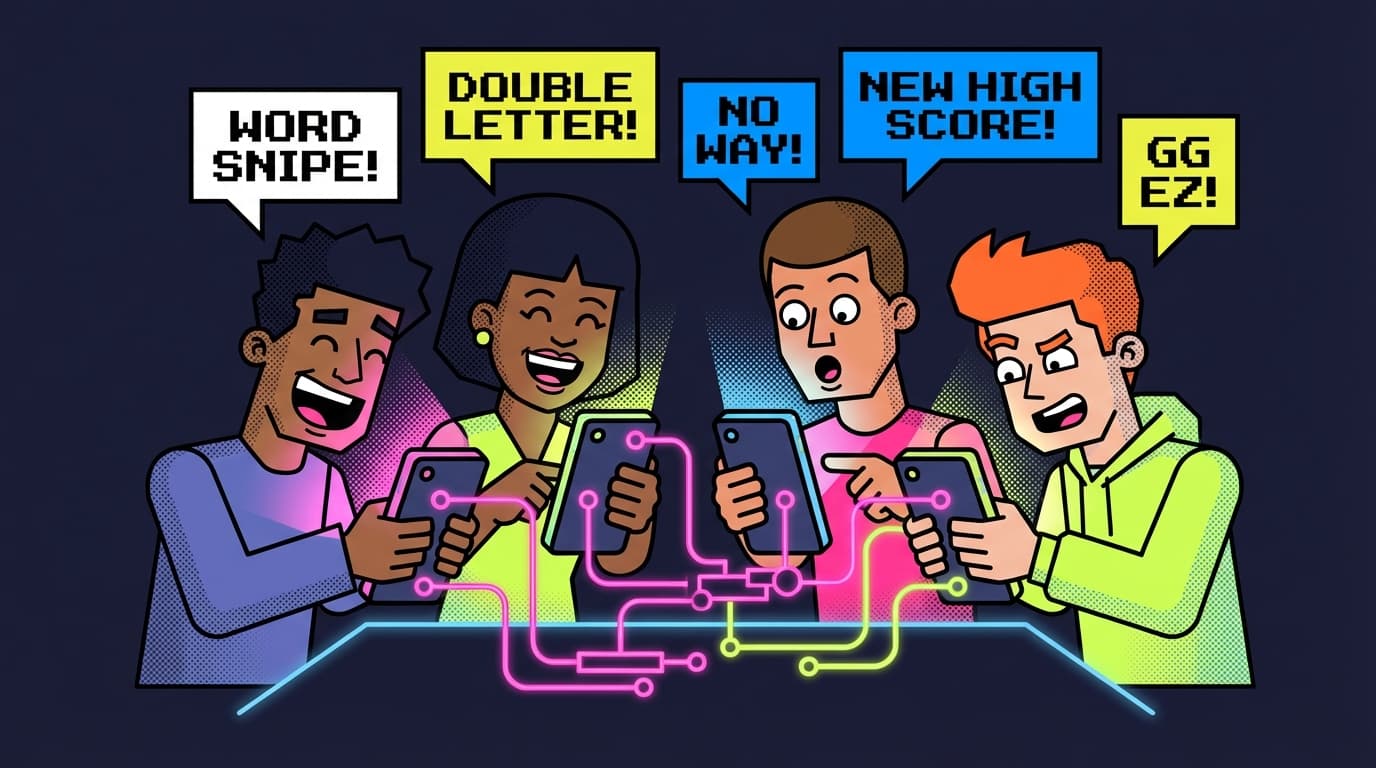
Last Friday night I had two options. Option A: curl up on the couch with my phone and grind through some solo word puzzles. Option B: drag four friends to my apartment, open some snacks, and spend three hours screaming at each other over a shared letter grid.
I chose Option B. Obviously.
And here's the thing — it wasn't just more fun. I played measurably better. My average word length went up. I found words I'd never have spotted alone. At one point I played QUIXOTIC and nearly blacked out from the dopamine rush, mostly because my friend Jake immediately called me a show-off, which somehow made it even better.
This isn't just me being dramatic (though I am, famously, dramatic). There's a growing body of research showing that playing word games socially — whether cooperative or competitive — activates different neural circuits than playing alone. Your brain literally operates in a different mode when other humans are in the mix.
Let me walk you through what we know, what we're still figuring out, and why game night might be the best thing you can do for your brain this week.
Solo vs Social: Two Different Brains
Here's something that surprised me when I first read about it. When you play a word game alone, the primary regions that light up are language-processing areas — Broca's area, Wernicke's area, the dorsolateral prefrontal cortex. Standard stuff.
But when you add other players — even just one — a whole additional network kicks in. Neuroscientists call it the "social brain network," and it includes the medial prefrontal cortex (mPFC), the temporoparietal junction (TPJ), and the posterior superior temporal sulcus (pSTS).
A landmark study by Redcay et al. (2010) published in Cerebral Cortex used fMRI to compare brain activity during solo tasks versus interactive social tasks. The social condition showed significantly greater activation in the mPFC and right TPJ — areas associated with mentalizing, or thinking about what other people are thinking.
In word game terms: when you're playing alone, you're just searching for words. When you're playing with others, you're simultaneously tracking what words they might find, anticipating their strategy, monitoring the social dynamics, and managing your own performance anxiety. Your brain is doing double duty.
This isn't exhausting — it's energizing. The social brain network co-activates with the reward system. Playing with others literally makes the game more rewarding at a neurochemical level.
I tested this informally on myself. I tracked my solo scores for a week, then my group-play scores for a week. My group scores were 15-20% higher on average. Part of that is social facilitation — a well-documented phenomenon where the mere presence of others improves performance on well-practiced tasks. Part of it is the competitive drive pushing me to dig deeper into my mental lexicon.
Competitive Cognition: Why Rivalry Sharpens Your Mind
Competition does strange things to the brain. And I mean that literally — fMRI studies show that competitive contexts activate the ventral striatum and anterior cingulate cortex in ways that cooperative or solo contexts don't.
A study by Decety et al. (2004) in Neuropsychologia found that when participants believed they were competing against another person (versus a computer), their brain showed enhanced activation in regions associated with reward anticipation and strategic planning. The key phrase there is "believed they were competing" — in some conditions, the "opponent" was actually a pre-programmed algorithm. But the brain didn't care. The belief that a real human was on the other side was enough to trigger the competitive neural cascade.
This maps perfectly onto my experience with word games. When I play against a bot, I'm engaged. When I play against Jake — who I know is going to trash-talk me if he wins — I'm locked in. Every fiber of my being is searching for that seven-letter word.
The mechanism seems to be related to social comparison theory, first proposed by Leon Festinger in 1954. We're hardwired to evaluate our abilities relative to others. In a competitive word game, every word your opponent finds is a data point your brain uses to calibrate its own performance. Am I falling behind? I need to try harder. Am I ahead? How do I maintain this lead?
This constant social calibration keeps the prefrontal cortex engaged at a higher level than it would be during solo play. You're not just solving a puzzle — you're solving a puzzle while simultaneously running a real-time competitive simulation in your head.
Here's the catch, though. Competition only enhances performance up to a point. Too much competitive pressure — especially in high-stakes environments — can trigger anxiety responses that actually impair cognitive function. The sweet spot is what psychologists call "optimal arousal" — competitive enough to be motivating, but not so competitive that it becomes stressful. This is why casual game nights feel so good. The stakes are low (bragging rights only), but the competitive drive is real.
The Jackbox Effect: Party Word Games and Collective Joy
If you've ever played a Jackbox party game, you know exactly what I'm talking about. There's a specific kind of joy that comes from wordplay in a group setting — a kind of collective creative electricity that doesn't exist when you're alone.
Game designers have a term for this: "shared creative space." It's the idea that when multiple people are generating ideas simultaneously — coming up with funny answers, creative wordplay, or unexpected associations — the group produces something greater than any individual could alone.
Research on brainstorming and group creativity supports this, with an important caveat. Osborn's original brainstorming research from the 1950s actually found that individuals generate more ideas alone than in groups, due to production blocking and evaluation apprehension. BUT — and this is a big but — the ideas generated in groups tend to be more diverse and more creative when the group dynamics are right.
Word games naturally create the right dynamics. The rules provide structure (you can't just say anything — it has to be a real word). The time pressure prevents overthinking. And the social setting provides immediate feedback — laughter, groans, "oh come ON, that's not a word."
I call this the Jackbox Effect: the phenomenon where word games in a party setting produce more creative, memorable, and emotionally resonant experiences than the same games played alone. It's why Quiplash answers are funnier when you hear the room react. It's why finding an obscure word in Boggle feels ten times better when your friend goes "WAIT, that's a WORD?!"
The neuroscience behind this involves mirror neurons and emotional contagion. When you see someone else react with surprise or delight, your brain mirrors that emotion. The joy of finding a good word gets amplified by the joy of seeing others react to it. It's a positive feedback loop of shared pleasure.
COVID and the Digital Connection Lifeline
I need to talk about 2020 and 2021. Because the pandemic fundamentally changed how we think about social gaming — and the research that came out of that period is fascinating.
When lockdowns hit, board game sales skyrocketed. But so did online multiplayer word games. Words With Friends saw a 40% increase in daily active users in March 2020. Scrabble GO launched in the middle of the pandemic and was downloaded millions of times. People were desperately seeking social connection, and word games provided a unique form of it.
A study published in Computers in Human Behavior (2021) by Vuorre et al. found that social video gaming during the pandemic was associated with better mental wellbeing — but only when the gaming involved actual social interaction, not just playing alongside others. The key ingredient was communication: chatting, competing, cooperating.
Word games are particularly well-suited for this because they're inherently communicative. Even in an asynchronous game of Words With Friends, you're communicating through your word choices. Playing QUAINT after your opponent plays QUIRKY? That's a conversation. A weird, lexical conversation, but a conversation nonetheless.
I played more online word games during lockdown than any other period of my life. And looking back, those games weren't really about the words. They were about maintaining connections. My weekly Boggle night over Zoom with college friends wasn't a gaming session — it was a social ritual disguised as a game. The word-finding was almost incidental. What mattered was the thirty seconds after each round when we'd argue about whether ZOEAE is a real word (it is — it's the plural of zoea, a larval stage of crustaceans, and yes, I am that person).
The research suggests this isn't unusual. Social gaming during isolation served a genuine psychological need, and word games — with their low barrier to entry, flexible pacing, and inherent conversational nature — were uniquely positioned to fill that role.
The Local Multiplayer Renaissance
Here's a trend I find genuinely exciting. After years of gaming moving increasingly online, there's a renaissance of local multiplayer — people playing games together, in the same room, on the same screen or around the same table.
The data backs this up. Board game cafes have exploded globally — there were an estimated 5,000+ worldwide by 2023, up from fewer than 1,000 in 2015. Party game sales have outpaced other board game categories consistently since 2019. And in the digital space, local multiplayer games like Overcooked, Jackbox, and Keep Talking and Nobody Explodes have proven that couch co-op isn't dead — it was just waiting for the right games.
Word games fit perfectly into this renaissance. You don't need expensive hardware. You don't need to learn complex rules. You need letters and humans, and you're good to go.
I've started hosting monthly word game nights. Nothing fancy — a few friends, some snacks, a timer, and a letter grid. What strikes me every time is how different the energy is compared to our online sessions. There's something about physical proximity that changes the experience fundamentally.
Part of it is nonverbal communication. A raised eyebrow when someone plays an unexpected word. The visible frustration of searching for a word you know is there. The synchronized groan when the timer runs out. These micro-interactions create a richer social experience than any chat window can replicate.
Research on co-located versus remote collaboration supports this. A meta-analysis by Baltes et al. (2002) in Organizational Behavior and Human Decision Processes found that face-to-face groups outperformed remote groups on tasks requiring coordination and creative problem-solving. The physical presence of other people provides social cues that enhance both performance and satisfaction.
Trash Talk as Bonding: The Paradox of Friendly Insults
Can I be honest about something? One of my favorite parts of multiplayer word games is the trash talk. And I don't think I'm alone in this.
There's a wonderful paradox at the heart of competitive social gaming: the insults bring you closer together. Calling your friend a "lexical fraud" when they play a two-letter word isn't aggressive — it's intimate. It signals a relationship secure enough to absorb playful hostility.
Psychologists call this "affiliative teasing," and it's been studied extensively. Keltner et al. (2001) published research in the Journal of Personality and Social Psychology showing that teasing serves crucial social functions: it tests and reinforces social bonds, establishes group norms, and creates shared humor.
In word games specifically, trash talk serves an additional function — it creates narrative. A round of Boggle without commentary is just a vocabulary exercise. A round of Boggle where Jake finds ZEPHYR and I respond with "oh sure, break out the Z words, very original, very creative, I definitely didn't see that" — that's a story. We'll reference it for weeks.
This narrative-building aspect of social gaming is underappreciated. Every game night generates inside jokes, recurring rivalries, and shared memories. My friend group still talks about the time Sarah played QOPH (a Hebrew letter) and sparked a twenty-minute debate about whether proper nouns should count. That was three years ago.
The research on shared experiences and relationship quality is clear: couples and friend groups who engage in novel, exciting activities together report higher relationship satisfaction. Word games tick both boxes — they're novel (every grid is different) and exciting (time pressure plus competition equals arousal). Add in the trash talk, and you've got a bonding activity that masquerades as a simple game.
Family Game Night: What the Research Actually Shows
I grew up playing Scrabble with my parents every Sunday evening. At the time, I thought it was boring (I was twelve — everything was boring). Looking back, it was one of the most formative experiences of my childhood.
The research on family game nights is surprisingly robust. A longitudinal study by Coyl-Shepherd and Newland (2013) published in the Journal of Family Issues found that families who regularly played games together reported stronger family cohesion, better parent-child communication, and higher family satisfaction — even controlling for other family activities.
Word games are particularly effective for families because they naturally accommodate different skill levels. A six-year-old finding CAT on the same grid where a parent finds CATASTROPHE isn't losing — they're playing a different game at a different level, and everyone can celebrate each other's victories.
I've watched this play out with my niece. She started joining our word game nights at age seven, finding three-letter words while the adults hunted for longer ones. Now she's eleven and routinely beats some of the adults. The progression happened naturally, through exposure and practice, without any formal vocabulary instruction.
There's also emerging research on intergenerational cognitive benefits. When grandparents play word games with grandchildren, both generations benefit — the grandparent gets cognitive stimulation and social engagement (both protective against cognitive decline), while the grandchild gets vocabulary exposure and one-on-one attention from a caring adult.
A 2022 review in Educational Psychology Review examined game-based learning in family contexts and found that the emotional warmth of family play creates what psychologists call a "low-anxiety learning environment" — conditions where learning happens most effectively. Kids who learn new words through games retain them better than kids who learn them through flashcards, and the family game night context makes the learning feel effortless.
Building a Word Game Community (And Why It Matters)
Let me zoom out for a moment. All of the research I've discussed points in one direction: word games are social technology. They're tools for connecting humans, and their cognitive benefits are amplified — sometimes dramatically — by social context.
This isn't just academic. It has practical implications for how we design, play, and share word games.
If you're playing word games solo, you're getting genuine cognitive benefits. The language processing, the working memory demands, the executive function — it's all real. But you're leaving a huge amount of value on the table.
Adding even one other person transforms the experience. You get social facilitation (better performance), competitive cognition (deeper engagement), emotional amplification (more fun), narrative building (lasting memories), and relationship strengthening (closer bonds).
I've seen this in my own life. The word game community I've built — a group chat where we share daily puzzle scores, a monthly in-person game night, the occasional online tournament — has become one of the most important social structures in my adult life. It sounds silly when I say it out loud. "My word game friends." But these are the people I see most consistently, laugh with most often, and feel most connected to.
The research on "third places" — social environments separate from home and work — suggests that regular, low-pressure social gatherings are essential for wellbeing. Word game nights are perfect third-place activities. They're structured enough to avoid awkward silences, flexible enough to accommodate different personalities, and engaging enough to keep everyone coming back.
So here's my pitch: start a word game night. Grab some friends, set up a grid, crack open some snacks, and play. You don't need to be good. You don't need to know obscure words. You just need to show up and be willing to argue about whether QI is a real word.
(It is. It's the circulating life force in Chinese philosophy. And yes, it's valid in Scrabble. I will die on this hill.)
Your brain will thank you. Your friendships will thank you. And when you find that perfect seven-letter word and the whole room erupts — trust me, nothing else hits quite like that.
T
The Word Nerd
Chronic word game evangelist who once made a stranger on a train play Boggle for four stops past their destination.