
Opinion
I Waited 11 Days for Someone to Play 'QI.' Then I Deleted the App.
Turn-based word games taught a whole generation that playing with friends means waiting for friends. Real-time word games are correcting that mistake.
September 12, 20269 min read
The notification arrived on a Tuesday: "Karen played QI for 22 points."
Eleven days. That's how long Karen — lovely Karen, mother of two, woman I see every week at trivia night — took to play a two-letter word. And here's the embarrassing part: when her move finally landed, I didn't feel excitement. I felt obligation. Now it was my turn, and the clock of social guilt had started ticking again.
I stared at the board for a second, realized I couldn't remember why either of us cared, and did what millions of people quietly do every year: I closed the app, and I never opened it again.
That's the dirty secret of turn-based word games. We don't finish them. We just stop, mutually, wordlessly, like two people who both pretended to enjoy a bad movie.
Turn-based was a compromise, not a feature
Here's something the app stores won't tell you: nobody designed turn-based multiplayer because it was fun. It was a workaround.
In 2009, when Words With Friends launched, phones had spotty connections, battery life was measured in hours, and push notifications were a novelty. "Your opponent will move eventually, we'll ping you" was the only multiplayer that technically worked. Async wasn't a design philosophy. It was a concession to hardware.
And it was fine! For 2010, it was great. But the constraint disappeared and the compromise stayed. We kept playing word games as a series of unread notifications long after our phones became capable of running real-time anything. The technology grew up. The genre didn't.
Compare it to every other kind of game you play with friends. You don't play Mario Kart by mail. You don't take a free kick, close the PlayStation, and wait for your friend to log in Thursday. The whole point of a game with another person is that the other person is there.
The math of a dead match
I did an audit of my own phone before writing this. Fourteen turn-based matches started in the past year. Nine died before move 20. Three are technically "active" but haven't seen a move in over a month — the multiplayer equivalent of a houseplant you keep forgetting to water. Two actually finished. Two.
And the finishing rate isn't even the worst part. The worst part is what async does to the feeling of competition. A word game is supposed to have tension — you're ahead, they're catching up, someone pulls a ridiculous word out of nowhere and the whole dynamic flips. Spread that across eleven days and it's not tension. It's a correspondence course.
Psychologists call it "context switching cost": every time a game asks you to re-enter days later, your brain has to reload the whole situation. Who am I playing? What's the score? What was my plan? Most of the time, the honest answer is "who cares," and the match quietly joins the nine others in the graveyard.
Group chats killed the two-player duel anyway
Even if you're the rare disciplined soul who finishes async matches, notice who they're with: exactly one other person, the two of you locked in a months-long duel neither remembers starting.
That's not how people socialize anymore. We socialize in group chats, in Discord servers, in family WhatsApp threads with one chaotic aunt. And async word games have no answer for the group. You can't run a turn-based game with eight friends — by the time turn six comes around, two people have changed phones.
The groups I know that still play word games together all converged on the same solution: one live room, one shared grid, everyone in at the same time. Not because someone pitched them on it. Because it's the only format that survives contact with a real group of humans who all have somewhere to be in twenty minutes.
What real-time actually feels like
The first time I played a real-time word battle, it was almost embarrassing how fast it escalated.
Same setup as always — a grid of letters, find words — except eight of us were on the same grid at the same moment, and the round lasted three minutes. Thirty seconds in, someone found QUARTZ and the group chat erupted. A minute later my brother-in-law, a man who has never beaten me at anything involving vocabulary, strung together a seven-letter word I'd scrolled past four times, and he will be dining out on it until roughly 2031.
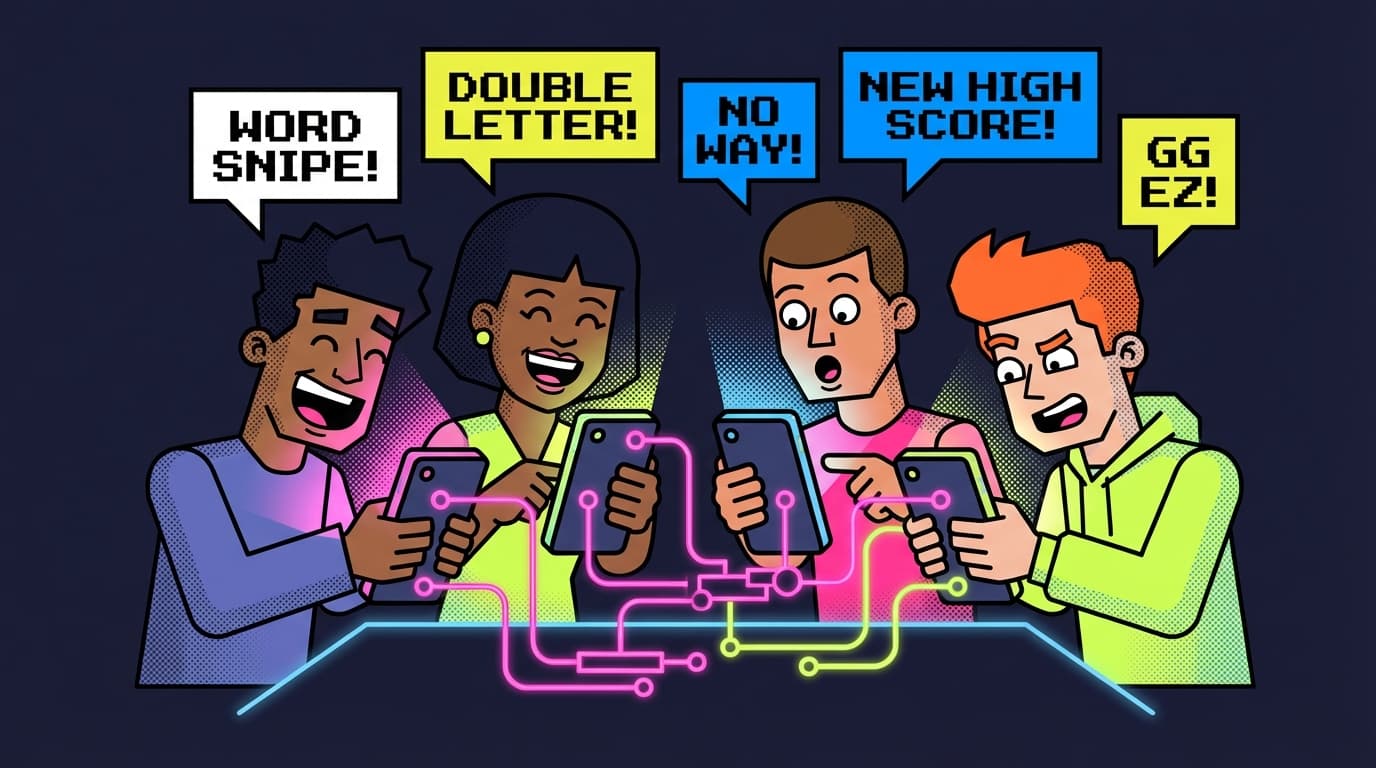
Three minutes. One winner. Zero notifications. When it ended, nobody said "your move." Everybody said "again."
That's the thing async could never deliver: a story. Something that happened to all of you, at the same time, that you can be insufferable about at dinner. Turn-based games generate admin. Real-time games generate lore.
When turn-based still wins (yes, really)
I'll be honest rather than right: async isn't dead for everyone.
If your word-game partner lives twelve time zones away, turn-based is genuinely the only way to share a game — and there's something sweet about a match that ambles along for months between two old friends. If you love the slow chess of Scrabble-style board control, where a single move deserves twenty minutes of thought, real-time will feel like being yelled at. And some people simply don't want another real-time thing in their lives. Fair. Genuinely.
But that's a niche, and we should call it one. "I want a slow, thoughtful, two-person word correspondence" is a taste. "I want to play word games with my friends" — the thing hundreds of millions of downloads were sold on — was never actually being served by apps that made you wait eleven days for QI.
How to get your friends actually playing tonight
The bar for a real-time word game night is comically low, which is kind of the point:
1. Pick a browser-based game. If anyone has to download an app or make an account, you'll lose two people immediately. (I run LexiClash rooms for exactly this reason — you share a link, people tap it, they're in. But the principle holds whatever you play.) 2. Put the grid on the biggest screen you have. TV, laptop propped on a shelf, whatever. Everyone else plays from their phone. Instant party. 3. Keep rounds short. Three minutes is the sweet spot — long enough for a comeback, short enough that losing stings for exactly as long as it takes to hit "rematch." 4. Play best-of-five and stop while it's still fun. The goal is that next week, someone else suggests it.
FAQ
Are turn-based word games dying? Not dead, but shrinking into a niche. The apps still have loyal daily players, but the cultural energy — downloads, group play, word-of-mouth — has moved to real-time and daily-puzzle formats. Turn-based increasingly serves long-distance duels and slow, deliberate play rather than mainstream social gaming.
What should I play instead of Words With Friends online? Look for a real-time word game that runs in the browser with no download and no account — that's what makes group play actually happen. LexiClash is built for exactly this: create a room, share one link, and up to 50 friends play the same letter grid live. Rounds take 2-3 minutes instead of days.
Is real-time better for parties and groups? Yes — real-time is the only format that scales past two players. Everyone plays simultaneously, so a round fits into a party, a classroom, or a family dinner. Turn-based games break down in groups because each turn multiplies the waiting.
Can I play word games with friends online for free? Yes. LexiClash is free, runs in any browser, and needs no signup: create a room, share the link or QR code, and friends join instantly from phones or laptops. Solo play against AI bots is free too.

Ohad Fisher
Founder & Editor-in-Chief, LexiClash
Founder and editor-in-chief of LexiClash. 8+ years designing word games and reading cognitive-science research. Every claim in my articles is sourced and fact-checked against peer-reviewed studies — see our editorial policy.