
Psychology
Why You Can't Stop Playing Word Games (And Why Your Brain Doesn't Want You To)
The science behind word game addiction — dopamine, flow states, and the psychology that keeps you coming back for "just one more round."
12 de noviembre de 20258 min read
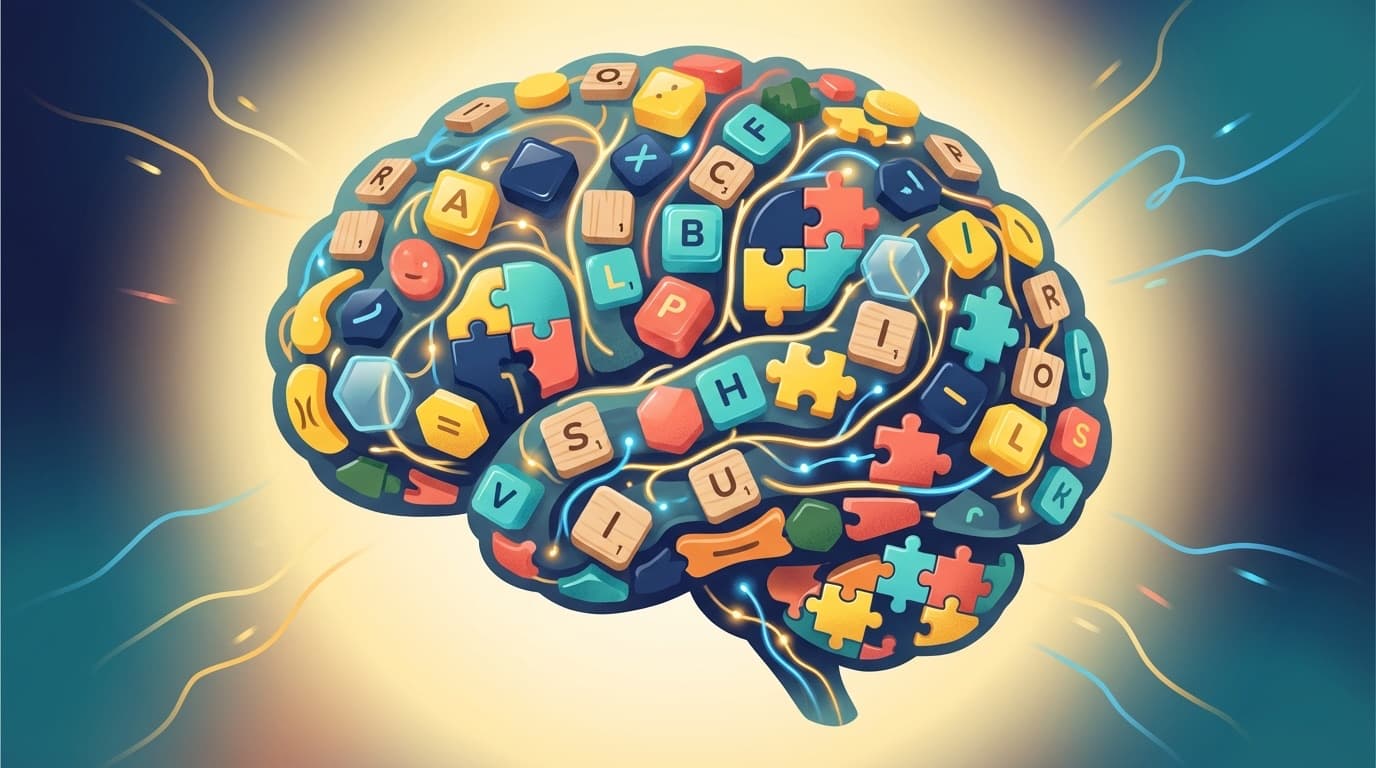
It was 2:17am on a Wednesday. I had work in five hours. My phone screen was the only light in the room, and I was hunched over a 4x4 grid of letters like Gollum cradling the One Ring.
"Just one more round," I whispered to absolutely no one.
That was four rounds ago.
If this sounds familiar, congratulations — you're not broken. You're experiencing one of the most elegantly engineered psychological loops that exists in gaming. Word games tap into something deep in how our brains are wired, and the result is a kind of compulsion that feels different from doomscrolling Instagram or binge-watching Netflix.
It feels... productive? Wholesome? Like you're doing something good for yourself even as your alarm clock inches closer?
I wanted to understand why. Not the vague "it's fun" explanation, but the actual neuroscience behind why word games are so absurdly hard to put down.
The dopamine hit: your brain on variable rewards
Dopamine is the obvious starting point. You've probably heard it called the "pleasure chemical," but that's not quite right. Dopamine is more accurately the anticipation chemical. It spikes not when you get the reward, but when you expect one might be coming.
This is why slot machines work. Psychologists call this a "variable ratio reinforcement schedule" — the most powerful conditioning pattern known to behavioral science.
Now think about what happens when you scan a grid of letters. You see a cluster: T, R, A, I... could that be TRAIN? You trace the path... N is right there. Five letters. Dopamine spike.
The devious part: you never know when you'll find the next word. Sometimes they come in rapid clusters, BAT, CAT, CHAT, boom boom boom. Other times you stare for thirty seconds seeing nothing, and then CATASTROPHE appears diagonally and your brain lights up like Times Square.
This unpredictability is the variable ratio schedule in action. Your brain learns that rewards come, but not on a predictable schedule, so it keeps you in a state of constant, low-level anticipation. Robert Sapolsky's work at Stanford showed that dopamine levels actually increase more when rewards are uncertain than when they're guaranteed.
Evolution did not prepare us for 4x4 letter grids.
Flow state: when time disappears
Ever looked up from a word game and realized an hour has passed? That's not a metaphor. Time literally feels different when you're in flow.
Mihaly Csikszentmihalyi identified flow state in the 1970s as a state of complete absorption in an activity. You lose track of time, your sense of self fades, and everything else drops away.
Flow requires a very specific balance: the challenge must be just hard enough. Too easy and you get bored. Too hard and you get frustrated. The sweet spot is where your skill level barely meets the difficulty.
Word games are accidentally perfect flow machines. A 4x4 grid contains hundreds of possible words, ranging from trivially easy (AT, TO, IN) to fiendishly difficult (that eight-letter word hiding in a spiral pattern). At any moment, you're operating at exactly the edge of your ability. The easy words keep you feeling competent. The hard words keep you challenged.
This is why a five-minute round can feel like thirty seconds. Your prefrontal cortex — the part responsible for time perception — gets recruited for the word-finding task instead. There literally aren't enough neural resources left over to track time.
The flow state is also why "just one more round" is so dangerous. Each round is short enough that the flow state doesn't fully dissipate between rounds. You're still riding the wave when the next grid appears.
The Zeigarnik effect: why unfinished puzzles haunt you
In the 1920s, Lithuanian psychologist Bluma Zeigarnik noticed something odd: waiters could remember complex orders perfectly while serving, but forgot them completely once the food was delivered. Uncompleted tasks stick in your memory. Completed ones get cleared out.
Word games exploit this ruthlessly. When your round ends and the game shows you all the words you missed, something happens. Those missed words create open loops. Your brain flags them as unfinished business.
"QUANTUM was on that board?! I saw the Q-U-A! Why didn't I see it?!"
That nagging feeling is the Zeigarnik Effect. Your brain has filed an incomplete task and it really wants to close that loop. The most direct way to close it? Play another round and try to find words like that next time.
Game designers know this. The end-of-round screen showing missed words isn't informational. It's a psychological hook. Every word you missed is an open loop. Every open loop is a reason to play again.
This is not normal behavior. But it IS normal neuroscience.
Social comparison: the leaderboard effect
Humans are comparison machines. Festinger's social comparison theory from 1954 argues that we evaluate ourselves primarily by comparing to others.
Word games with leaderboards plug directly into this circuit. It's not enough to find 30 words. You need to find more than your friend. You need to climb from 7th place to 5th. Competition activates the ventral striatum, the same reward center that responds to food, money, and romantic attraction. Beating someone on a leaderboard triggers a genuine neurochemical reward.
So you're getting two dopamine pathways activated simultaneously: one from the variable-ratio word-finding loop, and one from the social competition. A dopamine sandwich.
Daily challenges amplify this further. Everyone playing the same board on the same day creates a shared experience and a comparison framework that makes it irresistible to share and compete.
The "aha" moment: why finding words feels so good
There's a specific instant when you spot a word, especially a long one, where everything clicks. Beeman and Kounios showed using EEG and fMRI that insight moments are preceded by a burst of gamma-wave activity in the right temporal lobe, followed by a rush of activity in the reward centers — the same areas activated by jokes, pleasant surprises, and sudden understanding.
Finding a word doesn't just feel like a reward. Your brain processes it the same way it processes getting a joke or suddenly understanding something confusing. It's an insight, and insights are inherently pleasurable.
This is why finding a long, unexpected word feels categorically different from finding a short, obvious one. Finding "AT" is recognition. Finding "ATMOSPHERE" spiraling across the board is insight. Insight is neurochemically rewarded in a way that mere recognition isn't.
The pleasure is also amplified by what psychologists call the "generation effect." Words you actively discover are encoded more strongly in memory than words you passively read. Your brain rewards you for generating the information rather than just receiving it.
When "addictive" becomes a problem
Variable rewards, flow states, open loops, social pressure, insight rewards. These are genuinely powerful psychological mechanisms. The same mechanisms that make gambling addictive, social media compulsive, and mobile games predatory.
So when does word game "addiction" cross a line? Adam Alter draws it at interference. An activity becomes problematic when it consistently interferes with things you value more: sleep, relationships, work, physical health. Playing word games for an hour because you're enjoying yourself? Fine. Playing until 3am when you have an early meeting because you can't stop? Worth examining.
The good news is that word games are structurally less dangerous than many alternatives. Rounds are short with natural stopping points. There's no infinite scroll. There's no social media feed of curated envy. There's no financial mechanism.
But the Zeigarnik Effect can create compulsive play patterns in some people. If you find that missed words genuinely bother you for hours, or if you feel anxious when you can't play your daily challenge, it's worth being honest with yourself about whether the habit is serving you.
Why this "addiction" might actually be good for you
Compared to almost everything else competing for your attention, word game "addiction" is remarkably benign. Possibly even beneficial.
Doomscrolling social media: cortisol spikes from outrage content, social comparison anxiety, passive consumption, no cognitive challenge.
Word games: active cognitive engagement across multiple brain regions, vocabulary reinforcement, working memory exercise, strategic thinking, manageable dopamine cycles with natural endpoints.
A 2022 trial published in NEJM Evidence found that people who did crosswords for 78 weeks showed less cognitive decline than those using commercial brain training apps. The word game group actually improved on some measures while the app group stayed flat.
Your brain has been hijacked by dopamine loops, flow states, and open cognitive loops. But unlike most things that hijack your brain in 2026, this one is actually exercising it at the same time.
You're addicted to something that's probably making you sharper.
It's late. I should stop. But there's a seven-letter word hiding in that grid and my brain won't let me sleep until I find it.
Sources & Further Reading: - Sapolsky, R. — Dopamine and variable ratio reinforcement: Stanford lecture series on behavioral biology - Csikszentmihalyi, M. — Flow: The Psychology of Optimal Experience (1990) - Zeigarnik, B. — On finished and unfinished tasks (1927) - Festinger, L. — A Theory of Social Comparison Processes (1954) - Beeman, M. & Kounios, J. — The Aha! Moment: The cognitive neuroscience of insight (2009) - Alter, A. — Irresistible: The Rise of Addictive Technology (2017) - NEJM Evidence (2022) — Columbia & Duke University crossword trial (107 participants, 78 weeks)
Ohad Fisher
Fundador y Editor Jefe, LexiClash
Fundador y editor jefe de LexiClash. Más de 8 años diseñando juegos de palabras y leyendo investigación en ciencia cognitiva. Cada afirmación en mis artículos está documentada y verificada contra estudios revisados por pares — consulta nuestra política editorial.